The Horizon of Justice: The FBI’s Historic $8 Billion Cryptocurrency Seizure
Introduction to Operation Blackout
The Federal Bureau of Investigation recently announced the grandest cryptocurrency seizure in American history. This historic enforcement developed as part of a sweeping international crackdown against illicit cyber-fraud syndicates. Consequently, global authorities detained hundreds of criminal suspects. Furthermore, law enforcement successfully froze assets valued at over $8 billion.
The Demise of Prince Holding Group
The primary nexus of the investigation centers on 127,000 Bitcoins. Specifically, agents confiscated these massive funds from Chen Zhi, the influential chairman of Cambodia’s Prince Holding Group. This digital fortune currently carries a market value exceeding $8 billion. Remarkably, during the peak of the seizure window, the valuation reached a staggering $15 billion. Chen Zhi now faces federal indictments for wire fraud and money laundering conspiracy.
The Reality of Guarded Compounds
The extensive investigation penetrated heavily fortified compounds where captives endure forced labor to perpetrate online fraud. These specialized operations flourished across vast regions of Asia, Africa, and the Middle East. Meanwhile, the syndicates deliberately targeted American citizens as their primary victims. For instance, the FBI documented a single American citizen who tragically lost $3 million to these syndicates.
Advanced Geopolitical Complicity
Investigators directed intense scrutiny toward an armed militia known as the Democratic Karen Benevolent Army. This paramilitary faction operates within Myanmar and maintains deep ties to Chinese organized crime syndicates. Previously, the United States Department of the Treasury imposed severe economic sanctions against this entity. Eventually, the federal government formally designated the group as a transnational criminal organization.
Inside the Digital Sweatshops
The FBI explicitly emphasizes that these fortified operations are not mere telemarketing hubs. Instead, they operate as highly sophisticated criminal enterprises. These syndicates simultaneously execute financial theft, coordinate money laundering, and exploit human trafficking victims. Typically, operatives lure individuals with fraudulent promises of lucrative salaries and valid work visas. Subsequently, captors coerce victims into committing cyber-fraud under the immediate threat of torture and violence.
Global Enforcement Metrics
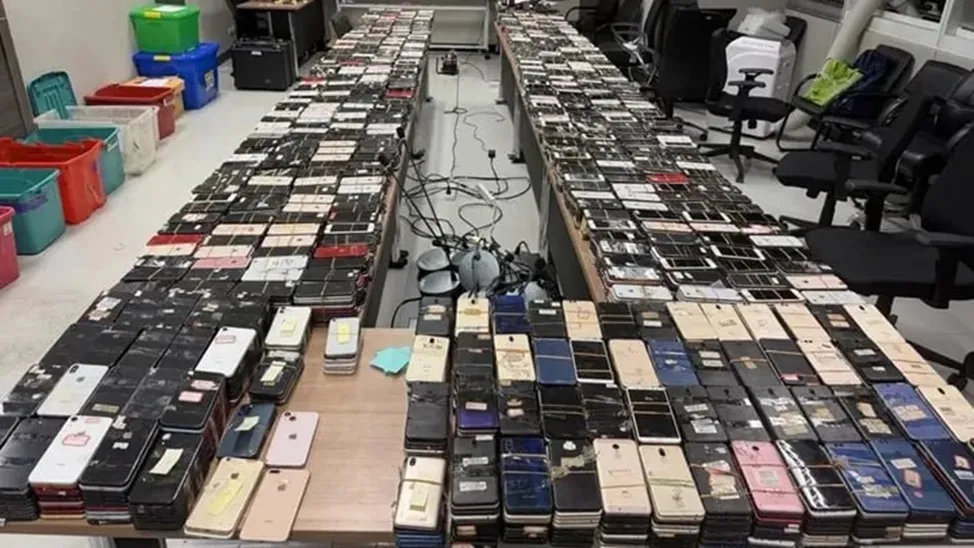
In Thailand, coordinated raids resulted in the seizure of thousands of mobile devices and processing equipment. Concurrently, Dubai authorities collaborated with the FBI to apprehend 275 individuals. Among these detainees, authorities will extradite six suspects to the United States to face federal prosecution. Financial audits revealed that each compromised compound generated roughly $6 million in annual illicit revenue.
Systemic Network Mapping
Prosecutors accuse the Prince Holding Group of orchestrating these militarized compounds across multiple sovereign borders. Federal authorities believe these operations belonged to a grander criminal matrix. Unquestionably, dismantling these sophisticated cartels represents a paramount priority for contemporary federal law enforcement.
The Anatomy of Project Sub-Operations
The overarching umbrella initiative, eloquently named Operation Blackout, comprised several distinct investigative vectors. First, Operation Zephyr Exodus focused entirely on the intricate networks of the Prince Holding Group. Second, Operation Sand Dollar targeted United Arab Emirates nodes that aggressively victimized American citizens. Finally, Operation Haochen directly confronted the Tai Chang compound within Myanmar’s militia-controlled territory. Here, the FBI successfully seized $30 million tied to illicit operations.
Dismantling the Shunda Compound
Furthermore, the Shunda Compound Takedown progressed seamlessly through a close partnership with Thai law enforcement. This specific campaign culminated in the arrest of two individuals within Thailand. Additionally, agents seized an active Telegram channel. The syndicate routinely utilized this digital platform to recruit human trafficking victims for elaborate impersonation schemes.
Dynamic Private Sector Collaboration
In a novel defensive maneuver, the FBI partnered directly with the Starlink satellite network. The bureau supplied precise geolocation telemetry to identify internet terminals operating within illicit compounds. Consequently, this brilliant technological synergy enabled the disabling of over 7,000 terminals across Myanmar.
The Rising Toll of Investment Fraud
The impetus for this massive mobilization stemmed from a surge of grievances submitted to the FBI in 2025. During that fiscal year, the Internet Crime Complaint Center received nearly 72,000 reports regarding cryptocurrency fraud. Tragically, the collective financial damage documented in these complaints surpassed $7.5 billion. However, directors believe the true economic devastation remains exponentially higher because many victims endure their losses in silence.
The Global Microeconomic Threat
According to calculations by the United States Institute of Peace, international syndicates plunder approximately $64 billion annually. These sophisticated operations masterfully blend cryptocurrency investment fraud, romance scams, and predatory extortion. Ultimately, they rely on the absolute subjugation of human beings forced into criminal service.
Proactive Interception Strategies
To counter this threat, the bureau initiated a proactive program named Operation Level Up. Through this framework, analysts identify vulnerable citizens who have already engaged with fraudulent investment portals. Investigators then intervene directly to warn these individuals before they execute subsequent wire transfers. Thus far, the FBI has notified 8,935 targets. Remarkably, 77% of these citizens remained entirely oblivious to their exploitation. To date, these timely interventions have successfully preserved over $562 million in private wealth.
Support Our Threat Intelligence
If you find our technology report and cybersecurity news helpful, consider supporting our work.
 Buy Me a Coffee
PayPal
Buy Me a Coffee
PayPal


