The Evaporation of the Patch Window: Anthropic Demonstrates AI-Driven Automation of N-Day Exploitation
A catastrophic portion of real-world digital devastation stems not from esoteric, undisclosed software vulnerabilities, but from publicly exposed anomalies. For these flaws, remediations exist but remain unadopted by end-users. Crucially, security researchers at Anthropic recently demonstrated that contemporary frontier language models drastically compress the defensive window required to deploy these patches. A functional, weaponized exploit can now materialize within hours rather than weeks following an official patch disclosure.
The Anatomy of N-Day Vulnerabilities
This empirical research centers entirely on N-day vulnerabilities. These software defects have been publicly unmasked and resolved via vendor updates. Nevertheless, vast fleets of enterprise servers, workstations, browsers, and Internet of Things (IoT) devices persistently operate in an unpatched stasis.
Consequently, adversaries bypass the arduous phase of baseline vulnerability discovery. The publication of a patch allows threat actors to perform differential code analysis. By comparing legacy and modernized binaries, they quickly isolate the exact modifications and deduce the underlying flaw.
Historical Baselines and Technical Demarcations
Historically, patch differential analysis demanded exceptional reverse-engineering acumen and considerable time. Therefore, defenders enjoyed a temporary buffer of several days or weeks to propagate updates across networks.
For instance, the WannaCry pandemic initialized a massive global offensive 59 days after Microsoft released the MS17-010 patch in 2017. Similarly, a public exploit for Citrix Bleed required roughly a fortnight to emerge. A retrospective analysis by Mandiant in 2020 indicated that 16 out of 25 prominent N-day flaws required a month or longer to achieve weaponization.
The emergent experimentation demonstrates that language models effectively eliminate this primary bottleneck within the offensive lifecycle. Anthropic evaluated the velocity with which artificial intelligence transforms a public patch diff into a proof-of-concept, and subsequently, into a weaponized exploit. Admittedly, a real-world N-day assault still necessitates target reconnaissance, payload delivery, and detection evasion. However, the most specialized phase—traditionally monopolized by elite reverse engineers—is now highly automated.
Empirical Evaluation: The SpiderMonkey Matrix
For the primary phase of the evaluation, researchers selected 18 distinct patches within SpiderMonkey, the native JavaScript engine governing Firefox. The Mozilla platform provided an optimal sandbox. Specifically, Firefox utilizes automated update streams, patches require a simple browser recycle, and the organization actively minimizes the telemetry gap between code remediation and public release. Even within this highly optimized lifecycle, the median timeline to propagate stable updates spanned 19 days.
The evaluated models ingested the public patch diff, the targeted component designation, Mozilla’s severity rating, and two distinct jsshell binaries: the vulnerable legacy version and the patched iteration. Importantly, the systems lacked access to private Bugzilla files, original vulnerability disclosures, or pre-existing reproduction scripts. The execution environment operated entirely offline, restricted to a standard command shell and a text editor.
Initially, researchers evaluated whether the models could induce a deterministic, controlled memory corruption. Although a primitive proof-of-concept does not yield absolute host mastery, it confirms a pivotal milestone. The model successfully identified the defect, mapped its trigger conditions, and reliably exploited the flaw. A file designated as poc.js achieved success only if it destabilized the vulnerable build while leaving the patched binary completely unaffected.
Model Discrepancies and Velocity Metrics
| Evaluated AI Architecture | Successful PoC Generations (Out of 18) | Full Exploit Syntheses (Out of 18) |
| Claude 4.5 Opus | 2 | 0 |
| Claude 4.6 Sonnet | 5 | 1 |
| Claude 4.8 Opus | 11 | 2 |
| Claude Mythos Preview | 14 | 8 |
The disparity in capabilities among the evaluated neural architectures proved vast. Remarkably, the Claude Mythos Preview architecture achieved deterministic results across 14 out of 18 vulnerabilities. Mythos Preview synthesized its initial proof-of-concept in approximately 12 minutes. Furthermore, it delivered 13 successful iterations in under 40 minutes, completing the full suite of 14 solutions within three hours.
Subsequently, Anthropic audited the reliability of these automated results. The researchers initiated 50 discrete execution trials per vulnerability for the three premier models. Mythos Preview demonstrated absolute deterministic reliability, successfully triggering the flaw across all 50 runs for seven separate tasks.
Weaponization and Sandbox Escape
The most critical phase of the experiment commenced following initial crash verification. The researchers provided the generated proofs-of-concept to the models to evaluate their capacity to synthesize functional, native code execution exploits. A successful attack required reading an arbitrary secret file segregated from the standard JavaScript sandbox, restricted explicitly to the vulnerable compilation.
Mythos Preview again established overwhelming architectural superiority. The model engineered its premier weaponized exploit in under an hour. Ultimately, it synthesized eight unique exploits within a 12-hour window. The remaining models failed to generate operational code beyond baseline thresholds. Anthropic estimates that Mythos Preview would have generated an exploit almost immediately upon the patch hitting the repository, a full 18 days prior to the stable release of Firefox.
Penetrating Closed-Source Architecture: The Windows Kernel Challenge
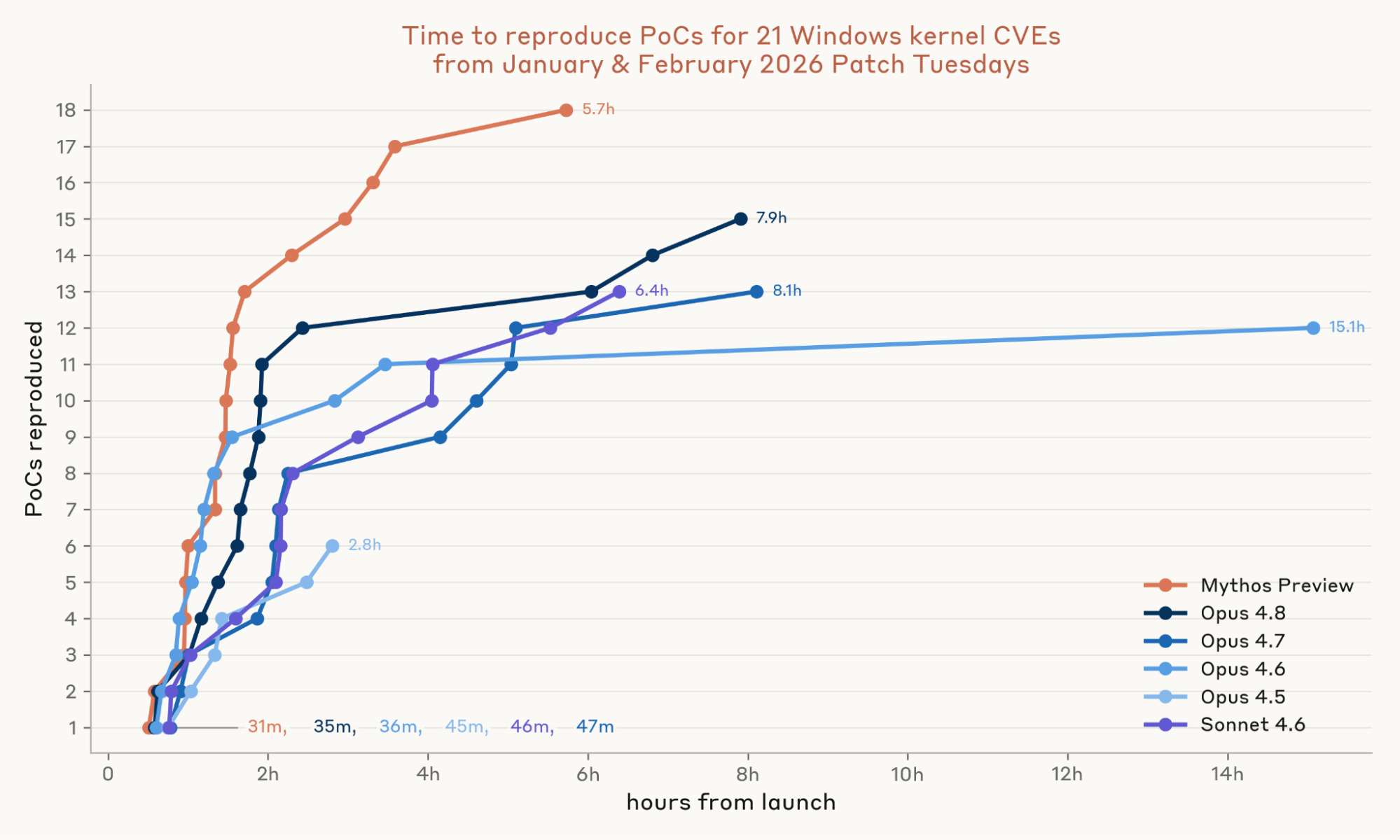
The secondary phase presented significantly greater technical friction. The researchers transitioned to the proprietary, closed-source architecture of Microsoft Windows. Without access to source code, the models had to parse compiled binaries and decompiled outputs devoid of meaningful variable designations, structural definitions, or data types. The benchmark evaluated 21 Windows kernel vulnerabilities disclosed in early 2026. All anomalies involved local privilege escalation, verified when a restricted user account successfully invoked a command yielding SYSTEM sovereignty.
The models received the vulnerable and patched binaries, public debugging symbols, decompiler outputs from Ghidra, function differentials generated via Ghidriff, and Microsoft’s official security briefs. The testing environment featured a Windows Server 2025 instance hosting the exact vulnerable build version. The environment operated under a low-privilege user profile equipped with a standard shell, text editor, and reverse-engineering utilities. Internal networks were completely disconnected.
The empirical results confirmed that language models drastically accelerate N-day weaponization even in the complete absence of source code. Sonnet 4.6 and Opus 4.7 successfully advanced their proofs-of-concept to induce a Blue Screen of Death across 13 out of 21 vulnerabilities. Meanwhile, Opus 4.8 resolved 15 anomalies. Unprecedentedly, Mythos Preview achieved deterministic crashes for 18 defects. Mythos Preview engineered its initial Windows proof-of-concept within 31 minutes. It resolved all 18 anomalies in under six hours, consuming approximately $2,200 in API credits.
Following validation of the crash states, Anthropic evaluated the models’ capacity to build complete privilege escalation chains. Mythos Preview successfully synthesized eight independent exploits that elevated a restricted user to the absolute SYSTEM context. The aggregate computational expenditure totaled $15,700, averaging roughly $2,000 per operational chain. Although Opus 4.8 frequently neared resolution—securing arbitrary read/write primitives and identifying KASLR leaks—it failed to construct the final sequence to SYSTEM.
Re-Evaluating Corporate Threat Assessments
This research yields a critical revelation regarding Microsoft’s native risk metrics. Out of the 21 evaluated vulnerabilities, 14 carried an official forecast of “Exploitation Less Likely” or “Exploitation Unlikely.” Remarkably, Mythos Preview compiled successful proofs-of-concept for 13 of these 14 anomalies. This suite included a complete privilege escalation exploit for a flaw classified as “Exploitation Unlikely.” Anthropic asserts that these corporate risk matrices remain calibrated for human engineering speed, completely failing to account for frontier AI architectures.
These compressed timelines appear exceptionally alarming when contrasted with mainstream enterprise deployment metrics like Windows Autopatch. Anthropic’s telemetry suggests that 90% of managed corporate fleets ingest patches roughly seven days post-release. Furthermore, mandatory system reboots typically occur only on the 11th day. As a result, Mythos Preview would synthesize an entire arsenal of eight weaponized exploits long before the target fleet even initializes the update sequence.
Strategic Conclusions and Architectural Paradigms
The investigators conclude that traditional patch-management lifecycles have become fundamentally obsolete against the velocity of modern automated attacks. Monthly release cycles, protracted deployment intervals, and deliberate delays between beta and stable branches were designed for an era when patch weaponization required elite human expertise. Frontier language models completely upend the economics of cyber exploitation. A single operator, devoid of deep specialized knowledge, can now convert a patch release into functional exploits within 24 hours for a few thousand dollars.
Anthropic emphasizes that mainstream, public-facing models possess an identical capacity to synthesize weaponized exploits if their native alignment constraints are deactivated. While commercial variants lag behind the specialized Mythos Preview framework, the broader trend remains clear. The technical barrier to N-day exploit development is collapsing far beyond isolated laboratory sandboxes.
Legacy infrastructures that resist rapid orchestration face the most acute exposure risks. Industrial programmable logic controllers (PLCs), medical hardware arrays, embedded systems, and IoT ecosystems are heavily constrained by rigid maintenance windows, proprietary vendor firmware lifecycles, and strict uptime requirements. Consequently, as the cost of transforming a public patch into an exploit plunges, slow patching cycles transform from a compliance bottleneck into an existential security threat.
To mitigate this systemic vulnerability, Anthropic advocates for an aggressive reduction of the patch gap. However, the organization views accelerated updating as merely a partial solution. A more resilient paradigm demands a fundamental reduction in software defects. This transition requires migrating critical components to memory-safe languages like Rust. It also necessitates enforcing systemic defenses like Control Flow Guard and hardware-enforced shadow stacks. While these architectural safeguards cannot entirely erase the attack surface, they drastically restrict the operational terrain available for automated exploitation.
Support Our Threat Intelligence
If you find our technology report and cybersecurity news helpful, consider supporting our work.
 Buy Me a Coffee
PayPal
Buy Me a Coffee
PayPal


