The Stealth Emergence of FROST: Tracking Users via SSD Latency Side-Channels
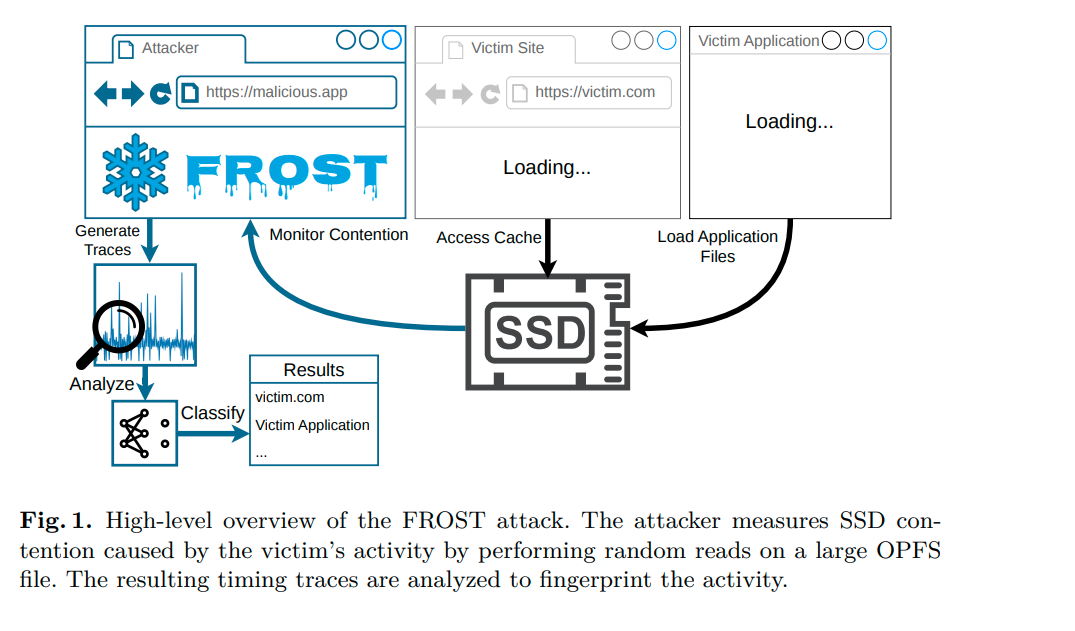
Websites possess a novel, obscured mechanism to monitor online visitors. Crucially, this approach completely bypasses traditional hardware peripherals like cameras, microphones, or weaponized browser extensions. Instead, it merely utilizes standard JavaScript code to detect minuscule operational delays within solid-state drives (SSDs).
Researchers designated this modern tracking methodology as FROST. This acronym signifies fingerprinting remotely using OPFS-based SSD timing. Specifically, the academic team demonstrated that an active webpage can infer an operator’s broader digital footprint. Consequently, the script identifies concurrent open tabs across distinct browsers and uncovers active background applications.
Deconstructing the Side-Channel Matrix
FROST exploits a profound hardware side-channel vulnerability. Generally, side-channel incursions harvest confidential system intelligence through indirect operational artifacts. These footprints include execution durations, cache states, electromagnetic radiation, or peripheral communication latencies. In this scenario, the tracking script measures how independent computing processes compete for immediate physical storage access.
The Role of the Origin Private File System (OPFS)
The exploitation vector functions natively through the Origin Private File System (OPFS). Natively, modern web browsers allocate this isolated storage sandbox to independent domains. This design empowers complex web applications to execute intricate storage workflows. Although this environment remains rigorously segmented from adjacent sites and the host filesystem, JavaScript can still audit internal read-and-write latencies.
The Interception Workflow
The attack sequence executes through a structured telemetry pattern. First, a malicious webpage instantiates an expansive file structure inside its designated OPFS partition. Subsequently, the script initiates continuous, randomized data-reading routines.
Whenever a user opens separate webpages or launches independent desktop applications, the physical storage drive must service an influx of concurrent input-output demands. Consequently, this intense computational rivalry alters local read latency parameters. Finally, a pre-trained neural network parses these minuscule timing variations to accurately classify active user operations.
Architectural Shifts and Structural Constraints
Undeniably, modern browsers have evolved far beyond basic document viewers. They now routinely power advanced office suites, multimedia editors, and fully functional development environments. While these modern capabilities enhance user convenience, they simultaneously expand the available attack surface.
Understanding System Limitations
Nevertheless, the FROST framework encounters notable structural limitations. Primarily, the exploit mandates the creation of a massive OPFS file target. This payload typically demands a storage footprint exceeding 1 gigabyte. As a result, mass deployment presents severe operational hurdles. This high visibility occurs because vigilant users would inevitably notice the anomalous storage consumption.
Furthermore, the OPFS asset must reside on the exact physical drive undergoing monitoring. This requirement poses minimal friction for web tracking. Principally, browsers uniformly store OPFS files within predictable system directories. However, if external applications operate from secondary storage volumes, FROST remains entirely blind to their execution.
Cross-Platform Verification and Defensive Protocols
Researchers successfully validated the complete end-to-end attack pipeline on an Apple Mac computing system powered by an M2 processor. Concurrently, they verified the underlying timing mechanisms on Linux architectures. Although the full classification suite was omitted on Linux, JavaScript successfully recorded the baseline storage latency deviations.
Hannes Weissteiner, a principal author of the study, highlighted these cross-platform similarities. Specifically, he expects comparable classification accuracy on Linux due to identical baseline hardware responses. Conversely, the engineering team has not yet audited the Windows ecosystem.
Proactive Mitigation Strategies
Fortunately, defending against this side-channel attack requires straightforward tactical workarounds. First, users should immediately terminate redundant background browser tabs. Second, advanced operators must routinely monitor local environments for anomalous, massive OPFS file creation.
Simultaneously, the researchers urged browser vendors to implement strict storage ceilings on OPFS allocations. This restriction would effectively neutralize the side-channel telemetry path. Currently, no empirical telemetry suggests that adversaries have deployed FROST within live corporate environments. Ultimately, the development cell will present their granular findings this July at the prestigious DIMVA conference.
Support Our Threat Intelligence
If you find our technology report and cybersecurity news helpful, consider supporting our work.
 Buy Me a Coffee
PayPal
Buy Me a Coffee
PayPal


