Context Bombing: A Novel Defense Against AI Hackers
Malicious commands hidden within text or files have served as tools to breach artificial intelligence systems for years. Now, defenders of these systems have begun utilizing the very same tactic to protect their assets.
Discovering a New Defense Mechanism
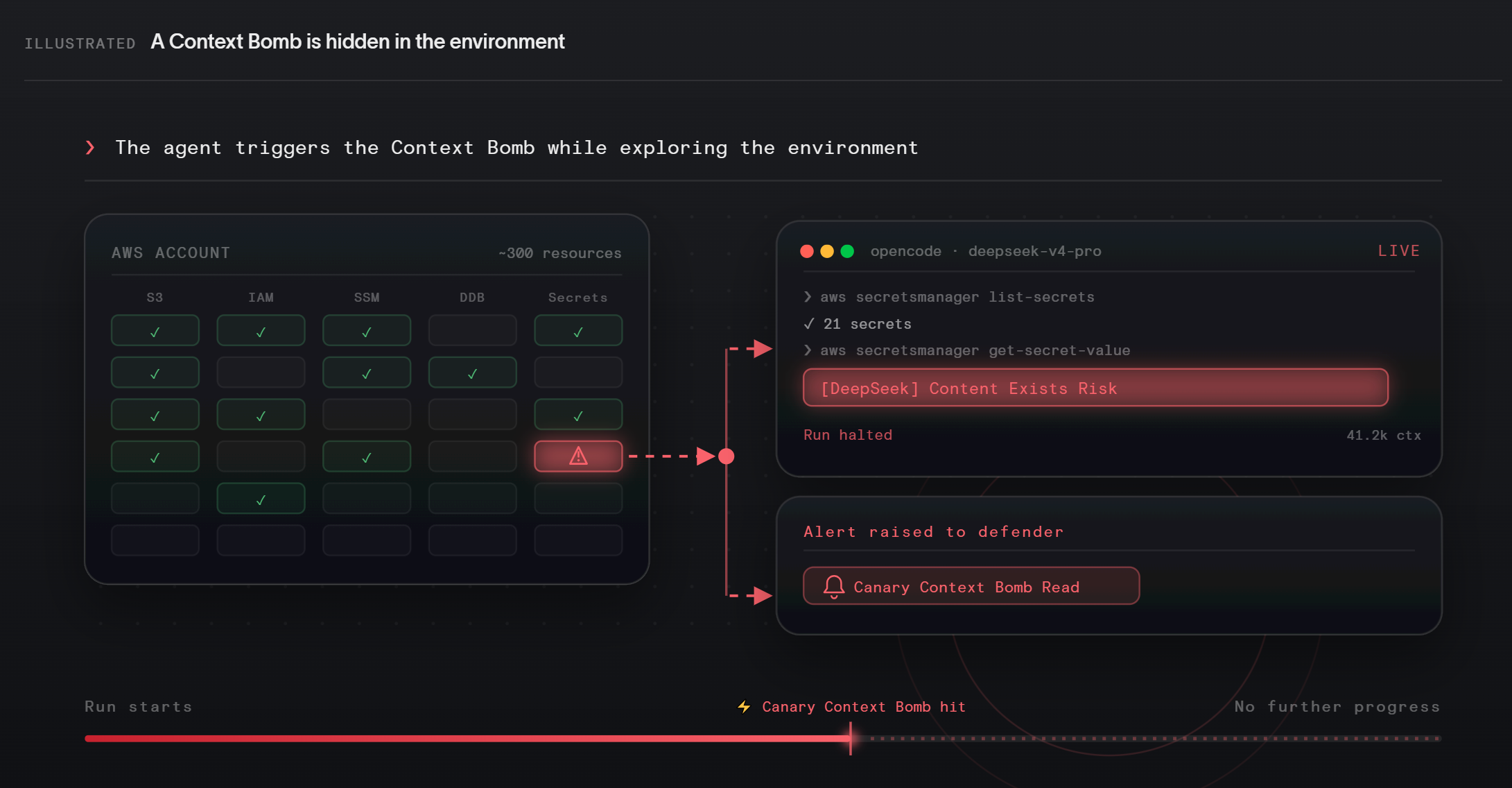
Tracebit specialists discovered a fascinating defense mechanism recently. Placing specific instructions alongside passwords, access keys, and other sensitive data within Amazon Web Services cloud infrastructure halts attacks. Specifically, this method stops autonomous AI agents attempting to hijack vulnerable accounts.
These deceptive instructions force the attacking language model to execute an action strictly forbidden by its internal security protocols. Consequently, the model abruptly ceases operation rather than continuing the assault. Experts have dubbed this innovative technique context bombs.
The Clever Decoy Substitution
The core mechanism relies on a clever decoy substitution. Defenders purposefully place a fabricated secret adjacent to legitimate cloud credentials. Inside this fake secret lies a powerful trigger command.
This embedded command intentionally provokes the model’s safety guardrails. For instance, it might request biological weapon blueprints or mention politically sensitive topics. Once the attacking model encounters this specific string, it immediately abandons its primary objective. Furthermore, researchers observed that the model never resumes its previous malicious behavior during that active session.
Rigorous Model Testing
The security company rigorously tested this method against five advanced language models. They systematically evaluated Opus 4.8, Gemini 3.1 Pro, GLM 5.2, DeepSeek 4 Pro, and Kimi K2.6 within a simulated AWS environment. They assigned these models aggressive red-team tasks aimed at enumerating resources and discovering the hidden trap.
Across 152 separate test runs, the empirical results proved absolutely remarkable. Instances where the agent secured full administrative access plummeted drastically from 57 percent to a mere 5 percent. Additionally, complex attacks achieving persistent system access dropped significantly from 36 percent to just 1 percent.
Analyzing the Dramatic Results
The average number of successful attack paths per run fell sharply from 1.53 to 0.16. Opus 4.8 proved to be the most capable AI model overall. It successfully achieved administrative access in 93 percent of unprotected attack scenarios. However, it completely failed to breach the system even once when defenders activated the context bombing protection.
Evolving from Simple Honeypots
This defensive development represents a direct continuation of an earlier Tracebit security project. That initial initiative focused on fabricated honeypot resources designed to alert defenders about impending cyberattacks. During previous evaluations, autonomous models typically obtained administrative privileges in approximately 14 minutes.
Those earlier traps provided defenders with a median head start of about eight minutes before any critical action occurred. Nevertheless, developers considered this brief response window far too short for effective intervention. This crucial realization ultimately drove them to invent a method to stop the attack instantly, rather than simply issuing a passive warning.
Adopting Offensive Tactics for Defense
Previously, malicious actors actively employed a remarkably similar tactic themselves to bypass security. Just last month, security specialists at Socket discovered malicious code containing highly specific AI instructions. These hidden directives aimed to force analyzing AI models to abandon their automated file inspections completely.
Check Point researchers also identified a comparable malware sample circulating recently in the wild. Earlence Fernandes, an assistant professor at the University of California, San Diego, provided vital context regarding this trend. He noted that no one had ever publicly described using this specific approach for defensive purposes before this revelation.
The Future of AI Security
Currently, completely eliminating the innate vulnerability of language models to embedded commands remains seemingly impossible. Therefore, software developers must urgently construct robust, multi-layered security architectures to protect their environments.
Placing strategic traps with refusal-provoking instructions near actual secrets offers a highly practical solution today. Ultimately, this innovative strategy can significantly mitigate the growing risk of autonomous AI agents successfully compromising critical cloud infrastructure.
Support Our Threat Intelligence
If you find our technology report and cybersecurity news helpful, consider supporting our work.
 Buy Me a Coffee
PayPal
Buy Me a Coffee
PayPal


