Sovereign Incursion: Unpatched Flaw Threatens Cisco SD-WAN Infrastructure
The Emergence of the Catalyst Threat
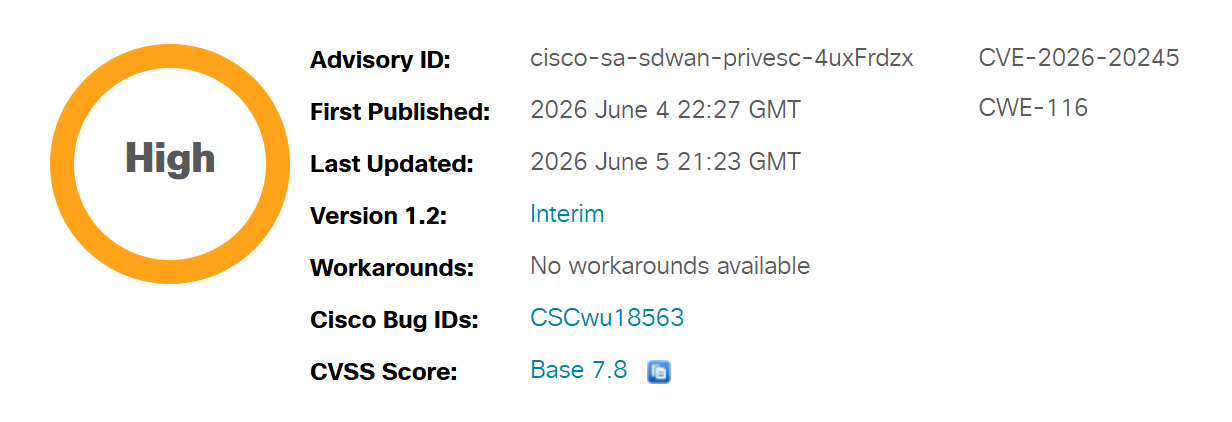
Cisco recently issued a critical advisory regarding its software-defined networking management architectures. Specifically, adversaries are actively weaponizing a novel vulnerability within the Catalyst SD-WAN Manager platform. Currently, an official engineering remediation remains entirely unavailable. Consequently, enterprises exposing these orchestration systems to the public internet face immense operational peril.
Scope of Exposure and Severity
The security defect carries the formal identifier CVE-2026-20245. Furthermore, it maintains a high-severity CVSS score of 7.8. This architectural flaw impacts on-premises deployments alongside Cisco SD-WAN Cloud-Pro environments. Similarly, it compromises cloud-managed variants and localized Cisco SD-WAN for Government installations.
Mechanics of the Privilege Escalation
The underlying error resides within the command-line interface of the Catalyst SD-WAN Manager. Historically, network administrators recognized this specific framework as SD-WAN vManage. An operator possessing standard netadmin privileges can effortlessly upload a meticulously crafted file. Subsequently, the system processes this input and executes arbitrary commands with absolute root authority. This severe breakdown stems directly from insufficient validation of user-supplied data streams. Therefore, an attacker injects malicious payloads to elevate privileges to the absolute maximum level.
Exploit Chains and Dependent Flaws
Crucially, executing CVE-2026-20245 requires valid netadmin credentials. Adversaries can obtain these prerequisites through credential theft or parallel exploit chains. In particular, threat actors frequently chain this defect with CVE-2026-20182 or CVE-2026-20127. At present, engineers have not identified alternative confirmed infiltration methodologies.
The Legacy Zero-Day Matrix
Disclosed in May 2026, CVE-2026-20182 maintains a maximum critical CVSS score of 10.0. This flaw permits unauthenticated remote actors to seize total administrative control over vulnerable hardware assets. Concurrently, a closely related vulnerability designated as CVE-2026-20127 compromises the identical core module. Both flaws previously endured active weaponization as potent zero-day exploits. Notably, security teams attribute the CVE-2026-20127 activity to an advanced threat cluster known as UAT-8616. Cisco telemetry indicates that this specific group has weaponized the defect since 2023.
Operational Fallout and Defensive Measures
Cisco recently documented a limited number of incursions where CVE-2026-20245 altered edge device configurations. However, the precise identities of the perpetrators orchestrating these campaigns remain entirely anonymous. Because functional hotfixes are completely absent, administrators must enforce immediate defensive perimeters. First, operators should immediately update their underlying SD-WAN software suites. Second, teams must verify the deployment of the May 14 patches for CVE-2026-20182. Additionally, defenders should rigorously audit the local /var/log/scripts.log file for indicators of compromise. Anomalous script executions involving tenant lists, vSmart serial allocations, or chassis numbering warrant immediate isolation.
A Systemic Pattern of Exploitation
Remarkably, CVE-2026-20245 marks the seventh Cisco SD-WAN vulnerability to suffer active exploitation in 2026. The expanding list includes CVE-2026-20182, CVE-2026-20127, CVE-2026-20122, CVE-2026-20128, CVE-2026-20133, and CVE-2022-20775. Furthermore, Cisco recently neutralized a separate flaw cataloged as CVE-2026-20230 within the Unified Communications Manager. Although a functional proof-of-concept exploit is publicly accessible for this utility, active in-the-wild manipulation remains absent.
Support Our Threat Intelligence
If you find our technology report and cybersecurity news helpful, consider supporting our work.
 Buy Me a Coffee
PayPal
Buy Me a Coffee
PayPal


