The Distributed Extraction: Masking Scrapers Behind Residential Networks
The Anatomy of the Data Harvest
Millions of standard residential IP addresses across the internet can convincingly mimic human readers. However, a malicious automated scraper often lurks behind this facade.
Consequently, the website Arab Reporters for Investigative Journalism (ARIJ) encountered this exact architectural dilemma. Within a single day, an adversarial distributed network began aggressively exfiltrating its extensive repository of investigative reports.
Quantifying the Traffic Spike
According to technical data published by Qurium, the English-language edition of the ARIJ platform endured a cataclysmic surge of automated traffic on May 14. Remarkably, the scale of this event exceeded the platform’s baseline page-retrieval metrics by a factor of ten thousand.
Therefore, this aggressive assault targeted a vulnerable non-profit organization based in Jordan rather than a commercial enterprise. This entity proudly champions independent journalism and rigorous fact-checking across the Arab world.
Network Telemetry and Perimeter Collapse
Forensics experts at Qurium meticulously audited several million lines of network access logs. Subsequently, they concluded that the extraction campaign persisted for nearly twenty-four hours.
During a concentrated twenty-three-hour window, the server processed inbound requests originating from 1.34 million unique IP addresses. Furthermore, this malicious traffic spanned 223 distinct countries and territories while traversing more than 7,300 autonomous systems.
Crucially, over three-quarters of these endpoints executed only a solitary query. This extreme rotation effectively neutralized traditional firewall defenses.
The Dilemma of Perimeter Defense
Thus, such a distributed paradigm renders perimeter defenses virtually useless at the individual host level. If administrators attempt to block entire geographical regions or internet service providers, the platform risks the alienation of its authentic audience.
Alternatively, enforcing strict rate-limiting thresholds severely disadvantages legitimate users residing in volatile regions. These individuals already suffer from unstable access to independent media.
Attributing the Residential Proxy Architecture
Qurium assesses that the observed behavioral pattern closely mirrors the operational profile of a major commercial proxy provider. Such entities utilize massive pools of residential carrier allocations. Meanwhile, they carefully throttle connections to avoid triggering localized threshold alerts.
Based on these specific behavioral heuristics, specialists tentatively linked the traffic to a network ecosystem designated as NetNut. However, a definitive forensic mapping of their internal infrastructure remains unproven.
The Bandwidth Monetization Matrix
NetNut commercializes premium residential proxy networks specifically designed for automated web-data harvesting. The enterprise proudly boasts access to vast international IP pools.
Moreover, the company maintains corporate ties with Alarum Technologies, an entity historically recognized as Safe-T Group. Qurium explicitly highlights the historical intersection between NetNut and DiViNetworks. The latter specialized in carrier-level integration frameworks and upstream bandwidth monetization.
| Entity Name | Corporate Relationship | Core Technological Specialization |
| NetNut | Subsidiary of Alarum Technologies | Automated Residential Data Harvesting |
| DiViNetworks | Historical Technology Partner | Carrier-Level Bandwidth Monetization |
Validating the Carrier-Routing Hypothesis
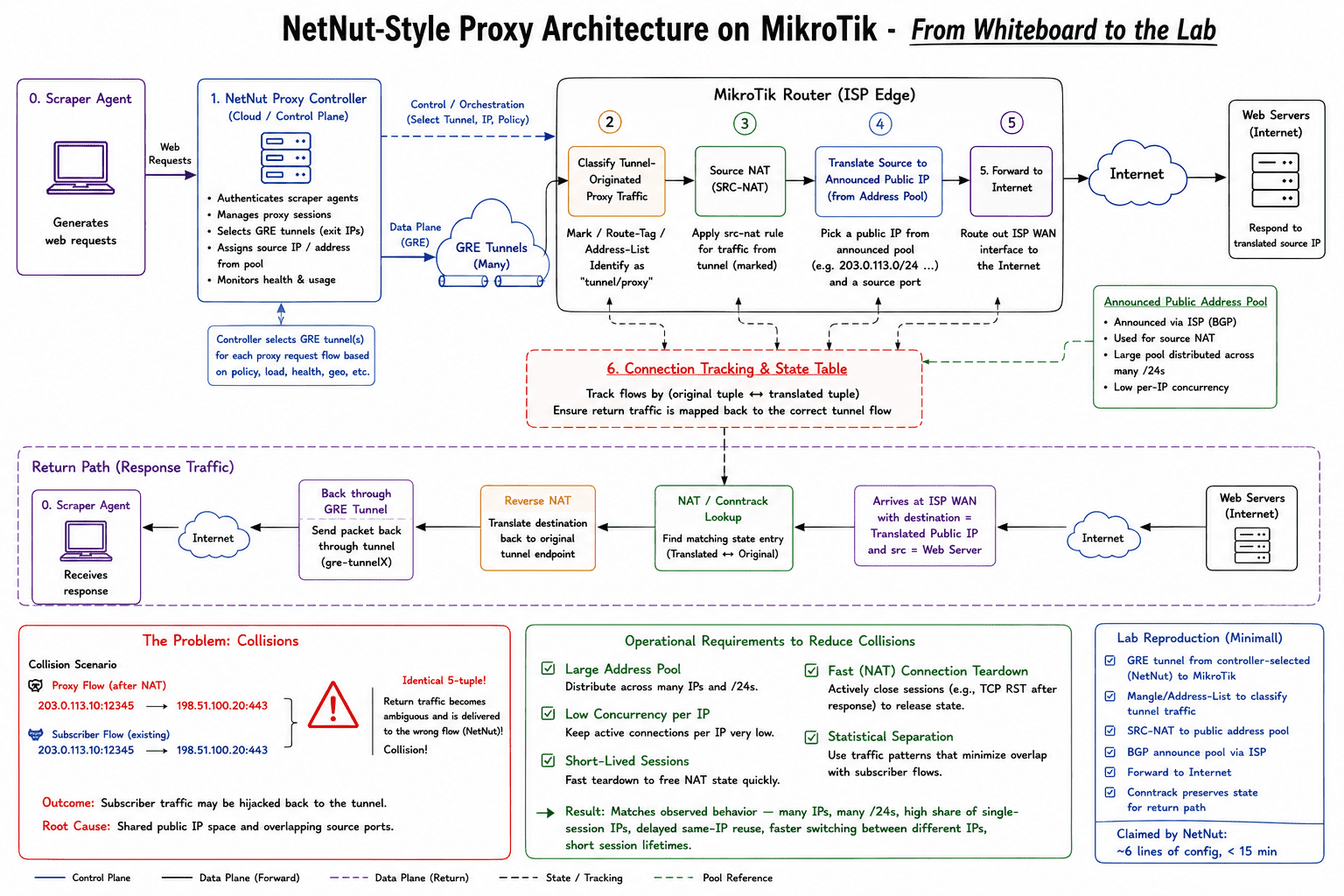
Under Qurium’s working hypothesis, such architectures manipulate carrier infrastructure seamlessly. External requests route directly through an encrypted channel before emerging onto the public internet via legitimate consumer allocations.
For the targeted web server, these incoming packets appear completely identical to standard consumer traffic. In reality, a remote third-party client initiated the transaction to fulfill a paid web-scraping contract.
Laboratory Proof-of-Concept
To validate the technical feasibility of this monetization model, Qurium constructed a proof-of-concept laboratory environment using a standard MikroTik router. In this experimental setup, incoming web queries routed through an isolated tunnel. Subsequently, the router executed address translation and discharged the traffic via simulated carrier space.
The experiment successfully demonstrated that standard networking tools can effortlessly replicate this foundational behavior. Nevertheless, hiding this traffic safely alongside authentic residential data requires an immensely sophisticated configuration layout.
Systemic Threats to Private Subscribers
Beyond the immediate computational strain imposed on target networks, the core architecture poses a much broader systemic risk. If carrier-level bandwidth monetization indeed operates via this methodology, consumer IP addresses become vulnerable to unauthorized exploitation. Consequently, everyday subscribers remain entirely oblivious to the external activities executing under their digital identities.
In the worst-case scenario, an innocent user surfaces as the apparent originator of malicious automated activity.
The Economic Realities of Opaque Scraping
Qurium sharply contrasts this behavior with ethical web crawlers and digital preservation initiatives. Legitimate bots transparently declare their identity and supply clear contact information. Furthermore, they strictly honor webmasters’ resource constraints.
Conversely, clandestine scrapers actively obscure their origins. These systems aggressively extract economic value from vital public-interest journalism. However, they callously shift the resulting financial liabilities onto the newsroom itself. The targeted editorial team must absorb the steep costs of bandwidth consumption, log management, resource allocation, and incident remediation.
The Rising Overhead for Independent Media
Currently, Qurium estimates that automated scraping entities consume at least one-quarter of the total network bandwidth across its client portfolio. For independent media houses and human rights organizations, this parasitic overhead proves exceptionally devastating due to their rigid budgetary limitations. Furthermore, administrators cannot simply deploy crude firewall filters without accidentally blocking access for their vulnerable human audience.
Strategic Conclusions and Ambiguous Motives
ARIJ Director General Rawan Damen stated that Qurium’s technical disclosure successfully clarified the operational mechanics of the data harvesting campaign. Nonetheless, the absolute attribution and strategic motivations behind this apparent assault by NetNut remain an objective for ongoing investigation.
Support Our Threat Intelligence
If you find our technology report and cybersecurity news helpful, consider supporting our work.
 Buy Me a Coffee
PayPal
Buy Me a Coffee
PayPal


