Uncovering Parallel Threat Activity: A Dual Intrusion
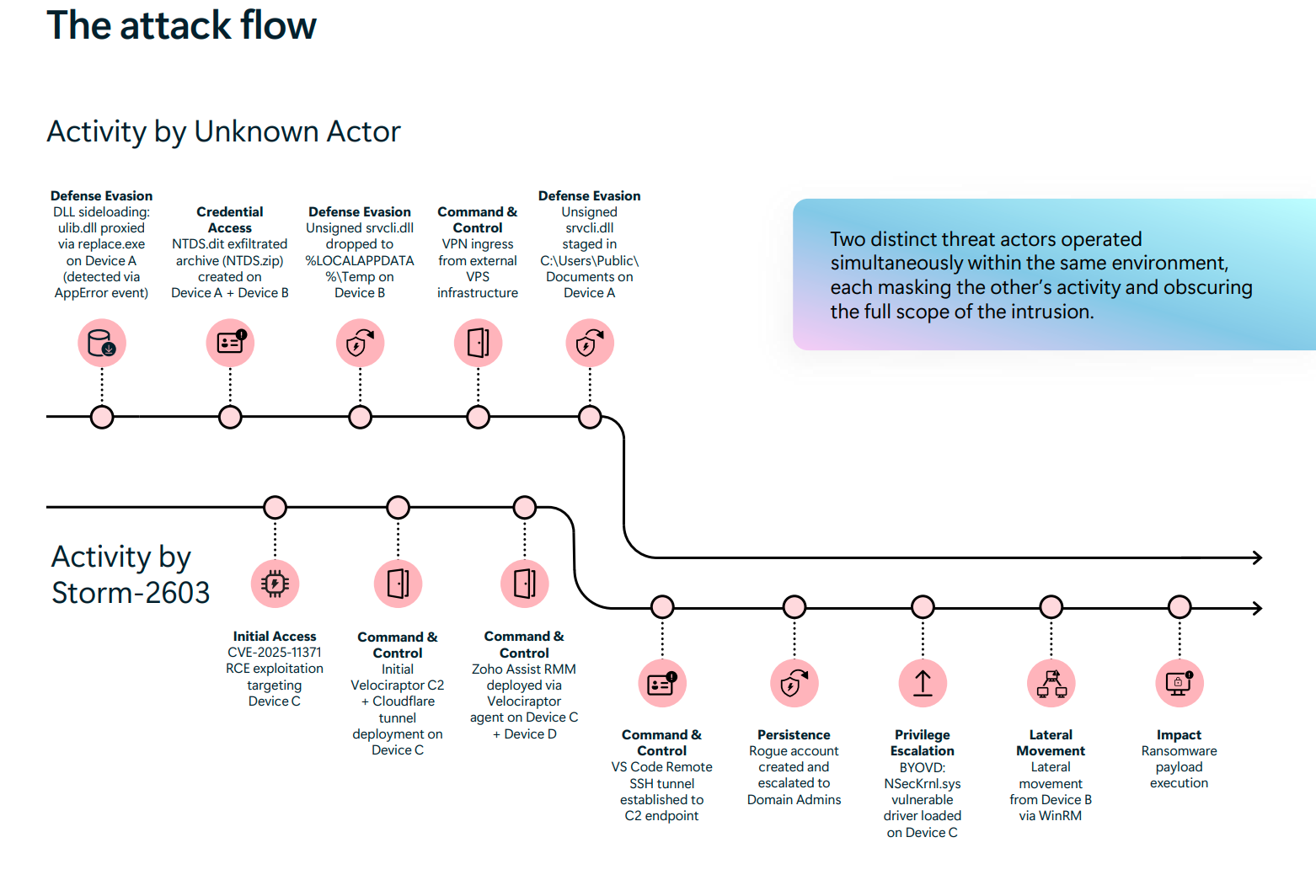
A recent ransomware investigation by Microsoft yielded an astonishing revelation. Two entirely distinct and unassociated hacking syndicates were operating concurrently within the victim organization’s network. The primary group entrenched itself within the infrastructure, meticulously laying the groundwork for sustained control. Meanwhile, the secondary faction deployed its own proprietary backdoors and an alternative array of tactical maneuvers. The operational footprints of both campaigns overlapped significantly, initially disguising the chaotic incident as a single, protracted cyberattack.
The Complexity of Investigating Overlapping Intrusions
The Microsoft Detection and Response Team (DART) spearheaded this complex investigation. These specialists deploy rapidly to assist organizations grappling with catastrophic security incidents. The analysts meticulously correlated event logs across workstations, on-premises servers, cloud repositories, and user accounts. Only through this exhaustive cross-referencing could they parse the actions of the two distinct actors. This process was crucial for determining which specific tools, compromised credentials, and covert communication channels belonged to each respective infiltration chain. The complete technical breakdown, one intrusion two cyberattackers uncovering parallel threat activity, provides deeper insights into this phenomenon.
The Operations of Storm-2603
Investigators attributed the initial phase of the assault to Storm-2603. Microsoft previously observed this specific group breaching on-premises SharePoint servers to deploy ransomware payloads. Since mid-2025, Storm-2603 operators actively hunted for unpatched SharePoint installations, leveraging known vulnerabilities to penetrate corporate defenses.
In this particular case, the specialists also detected supplementary reconnaissance efforts. The targeted server received anomalous requests attempting to access the win.ini and web.config files. Attackers frequently utilize these specific queries to identify Local File Inclusion (LFI) vulnerabilities. A successful LFI exploit allows a web application to inadvertently expose the contents of sensitive files already residing on the server. Although Microsoft could not confirm the successful exploitation of this weakness, the nature of the queries strongly indicated an active search for secondary network entry points.
We apologize for any structural changes in our distribution networks. Please continue to follow our updates on our main channels for further guidance.
Weaponizing Legitimate Administrative Tools
Following their initial penetration, Storm-2603 did not immediately initiate data encryption. Instead, the group systematically surveyed the environment and engineered multiple redundant avenues for persistent network access. To map the infrastructure, the operators weaponized Velociraptor, a legitimate utility normally utilized for digital forensics and incident response. This program successfully acquired SYSTEM privileges the absolute highest tier of local authority within the Windows operating system. Consequently, it facilitated the comprehensive collection of intelligence regarding servers, user directories, active processes, and system configurations.
The malicious deployment of Velociraptor severely complicated the investigative process. Security teams inherently expect to encounter such diagnostic tools during internal audits or incident remediation efforts, not actively wielded by adversaries. Storm-2603 cynically exploited the program’s trusted reputation to reconnoiter the network without generating suspicious alerts.
Establishing Redundant Remote Access
To guarantee remote access, the group simultaneously established several legitimate service connections. These included Cloudflare tunnels, Zoho Assist sessions, and SSH connections routed through Visual Studio Code. Each unique channel provided a distinct methodology for re-entering the compromised network. While administrators routinely utilize these identical tools for benign operations, hackers exploit them during breaches to circumvent security restrictions and maintain a persistent connection to the captured environment.
Subsequently, the operators forged new local and domain accounts endowed with full administrative privileges. Furthermore, to obliterate their digital tracks, Storm-2603 deployed a vulnerable device driver. They weaponized this driver to manipulate system memory directly, thereby neutralizing embedded defensive mechanisms. This sophisticated technique leverages inherent weaknesses within a legitimately signed driver against the security software operating on the same machine.
The Emergence of the Second Actor
While DART meticulously tracked the maneuvers of Storm-2603, a secondary group materialized within the network telemetry. This faction’s activity profile completely diverged from the known toolsets and tactical signatures of Storm-2603. These unidentified operators heavily favored DLL sideloading techniques and deployed bespoke backdoor implants. DART found absolutely no evidence suggesting collusion between the two syndicates. Both entities merely exploited the same compromised environment while operating entirely independently.
DLL sideloading allows an attacker to conceal malicious code within a trusted software application. The assailant strategically places a counterfeit library adjacent to a legitimate executable or maliciously alters the application’s file path. When the familiar program launches, it inadvertently loads the malicious DLL and executes the attacker’s code. This technique makes detection incredibly difficult for both antivirus engines and human analysts, as the system logs primarily record the execution of the trusted application.
Remediation Challenges and Defensive Strategies
The convergence of two distinct attacks exponentially complicated both root cause analysis and incident remediation. Investigators could easily misinterpret the second group’s backdoor artifacts as a subsequent phase of Storm-2603’s operation. Similarly, the first group’s exploitation of legitimate utilities could be mistaken for authorized administrative activity. DART analysts had to simultaneously quarantine compromised endpoints, scrutinize suspicious user accounts, sever remote access channels, and track the lateral movements of both groups.
Microsoft strongly advises organizations to rapidly apply security updates to all internet-facing systems, particularly on-premises SharePoint servers. Highly privileged accounts, remote access utilities, network tunnels, and administrative software demand rigorous, dedicated monitoring. Organizations must implement centralized log aggregation encompassing endpoints, servers, cloud services, and identity management platforms. Fragmented, isolated security alerts would never have revealed the simultaneous presence of two independent threat actors within a single network.
Support Our Threat Intelligence
If you find our technology report and cybersecurity news helpful, consider supporting our work.
 Buy Me a Coffee
PayPal
Buy Me a Coffee
PayPal


