FortiBleed Campaign Exploits Tens of Thousands of Fortinet Firewalls
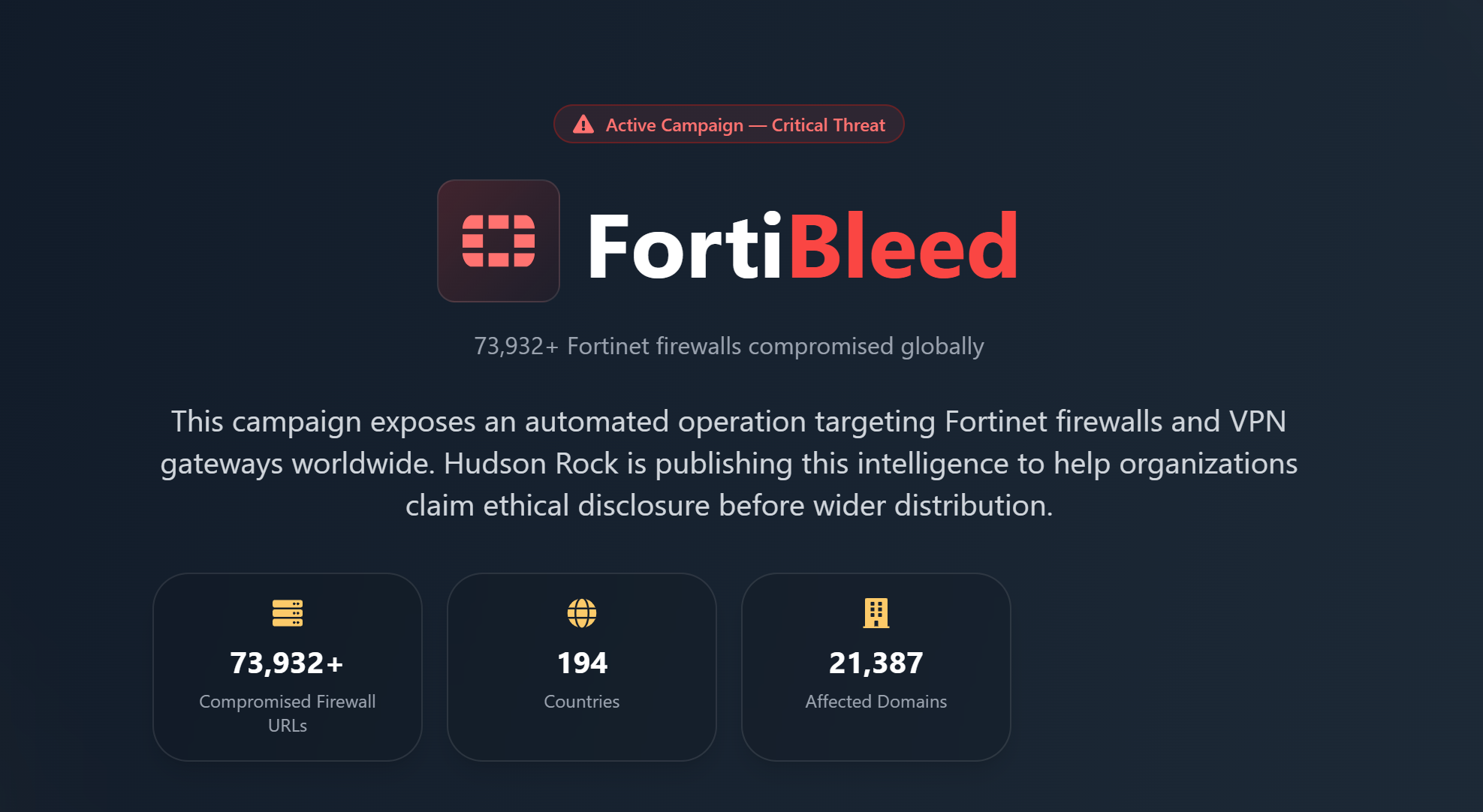
Major corporate enterprises across the globe may have inadvertently left their digital entryways exposed for years, utilizing keys already held by malicious actors. Cyber security specialists have unveiled a massive operational offensive designated as the FortiBleed campaign. Throughout this onslaught, threat actors successfully intercepted and compromised tens of thousands of Fortinet firewalls and FortiGate Virtual Private Network (VPN) gateways, jeopardizing infrastructure integrity globally.
A Pragmatic and Perilous Exploitation Strategy
This malicious campaign does not appear to rely on the orchestration of an intricate zero-day vulnerability. Rather, the adversary’s methodology is far more rudimentary and dangerously effective: attackers scan the public internet for exposed Fortinet appliances and systematically authenticate against them utilizing previously leaked or brute-forced credentials. Upon securing illicit administrative access, the compromised gateway is subverted to intercept and monitor network traffic. Through this covert posture, attackers harvest fresh user credentials and leverage these newly captured passwords to pivot and deepen their incursions across the enterprise structure.
Quantifying the Global Infiltration
The true scale of this security anomaly has triggered alarming metrics from threat intelligence firms. Data intelligence experts at Hudson Rock identified specific indicators of compromise across 73,932 unique firewall addresses spanning 194 countries. Concurrently, a security analysis published by SOCRadar estimated the volume of affected devices to comfortably exceed 30,000. Within the exposed datasets, researchers identified 21,632 distinct corporate domains. Potential victims include massive multi-national organizations such as Accenture, Comcast, Foxconn, Lenovo, Oracle, Samsung, Siemens, and PwC, alongside various government institutions and critical infrastructure operators. In response to this crisis, researchers have engineered a complimentary tool allowing businesses to verify their vulnerability status regarding FortiBleed explicitly.
Geographic and Industrial Demographics
According to telemetry data analyzed by security groups, the highest concentration of compromised appliances resides within India, the United States, Taiwan, Mexico, Turkey, Thailand, Colombia, Malaysia, Chile, and the United Arab Emirates. From an industrial perspective, the threat actors predominantly prioritized telecommunications, information technology services, financial ecosystems, state administrations, healthcare frameworks, academic institutions, and manufacturing conglomerates.
Anatomy of the Infiltration Server
The initial revelation regarding this massive credential exposure was brought to light by prominent independent security researcher Bob Diachenko. He discovered an exposed, public-facing repository containing a database populated with unencrypted usernames, email addresses, and plain-text passwords. His technical analysis revealed that the threat group had conducted approximately 1.16 billion authentication attempts across 320,777 unique FortiGate hosts, alongside an additional 2.1 billion brute-force attempts targeting 163,650 Microsoft SQL Server endpoints. Diachenko further established that the rogue repository retained internal operational scripts, configuration logs, command histories, and clear forensic footprints left by the cybercriminal syndicate.
Venerable independent cybersecurity professional Kevin Beaumont scrutinized a substantial subset of the leaked intelligence and verified its authenticity. He estimated the underlying database encompasses records from roughly 75,000 Fortinet appliances, noting that the vast majority remain critically accessible via the open web. Beaumont hypothesized that a fraction of the credentials may have been exfiltrated from exported Fortinet setup configurations, given the structural format of the data. However, the precise vector used to accumulate the master database remains officially undetermined.
Corporate Countermeasures and Recommendations
Fortinet has formally acknowledged its awareness of this third-party credential harvesting operation targeting its firewall and VPN gateway frameworks. The corporation maintains that the published data repository represents an aggregate compilation of older, recycled breaches combined with aggressive credential-stuffing attacks. They emphasize that the incident is not indicative of an unpatched software flaw, recent corporate breach, or novel security advisory.
To fortify digital perimeters against FortiBleed, security professionals advise organizations to immediately rotate all passwords associated with Fortinet administrative interfaces and VPN access portals. Furthermore, enterprises must universally enforce multi-factor authentication (MFA), meticulously audit gateway access logs for anomalous behavior, and actively monitor corporate identity credentials across darknet repositories to ensure staff profiles have not been broader casualties of external data breaches.
Support Our Threat Intelligence
If you find our technology report and cybersecurity news helpful, consider supporting our work.
 Buy Me a Coffee
PayPal
Buy Me a Coffee
PayPal


