Microsoft Discovers Crypto Clipper Utilizing Tor for Control
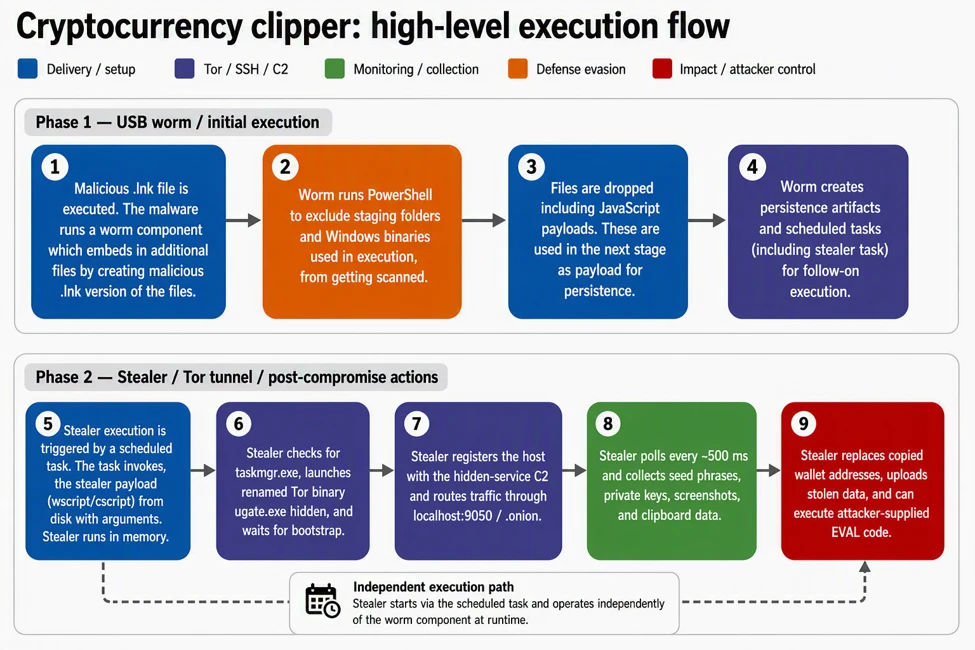
Malicious software architectures are increasingly eschewing conspicuous command-and-control infrastructures. Instead, they seamlessly conceal communications with their operators deep within anonymous networks. Recently, Microsoft meticulously chronicled a sophisticated campaign targeting cryptocurrency holders that exemplifies this exact tactical evolution.
The Anatomy of the Threat
According to the company’s cybersecurity specialists, adversaries have been propagating a sophisticated “clipper” malware since February 2026. This malicious tool is specifically engineered to manipulate cryptocurrency wallet addresses and exfiltrate highly confidential data. The defining characteristic of this sophisticated scheme is the malware’s integration of an embedded Tor client. This allows it to establish covert communication channels with its command server via hidden services. Furthermore, it possesses the capability to execute arbitrary commands transmitted remotely.
The initial infection vector relies heavily on compromised USB storage devices. A malicious Windows Shortcut (LNK) file is strategically deposited onto the flash drive. Upon execution, this deceptive shortcut initiates a rapid system diagnostic to ascertain if the host is already compromised. If not, it silently downloads supplementary, malicious payloads. Subsequently, the worm obfuscates legitimate documents residing on the drive and generates fraudulent shortcuts bearing identical nomenclature. Consequently, an unsuspecting user believes they are opening a standard PDF or DOCX file; in reality, they are triggering the execution of malicious code.
The malware operates via two primary modules. The first module governs the worm’s lateral movement, ensuring its continued proliferation across removable media. It also establishes persistence within the infected system by manipulating scheduled tasks. The second module functions as the core clipper mechanism. It relentlessly monitors the system’s clipboard, harvests sensitive cryptocurrency wallet data, and securely transmits this intelligence to the threat actors.
Evasion and Exploitation Tactics
As detailed in the comprehensive report where crypto clipper uses Tor worm like propagation for persistence control, the post-execution phase is highly orchestrated. The malware activates its disguised Tor client, generates a unique victim identifier, and officially registers with the command-and-control server. From this point forward, the program persistently anticipates remote directives. It interrogates the clipboard approximately twice per second, hunting for seed phrases, private cryptographic keys, and wallet addresses. Upon identifying a cryptocurrency address, the malware can surreptitiously substitute it with an address controlled by the attackers. Additionally, the program periodically captures and transmits screenshots via the Tor network.
Microsoft researchers observed that the clipper utilizes the Windows Script Host and ActiveX components to interact deeply with the operating system. Demonstrating advanced evasion capabilities, the malware immediately terminates its operations if it detects the Windows Task Manager running. Furthermore, if the command server issues a specific “EVAL” directive, the malware can dynamically execute arbitrary code supplied by the attackers during runtime.
Strategic Defense Recommendations
To fortify defenses against this insidious threat, Microsoft strongly advises a paradigm shift toward behavioral analysis, rather than relying exclusively on traditional signature-based detection. The corporation specifically recommends disabling AutoRun and AutoPlay functionalities for all removable media. Furthermore, administrators should leverage Group Policy to explicitly prohibit the execution of LNK files originating from external drives. Finally, organizations must restrict the utilization of wscript.exe and cscript.exe, while vigilantly monitoring for anomalous activities concerning clipboard manipulation and unauthorized screen captures.
Support Our Threat Intelligence
If you find our technology report and cybersecurity news helpful, consider supporting our work.
 Buy Me a Coffee
PayPal
Buy Me a Coffee
PayPal


