The Underminr Paradigm: Subverting DNS Filters via CDN Networks
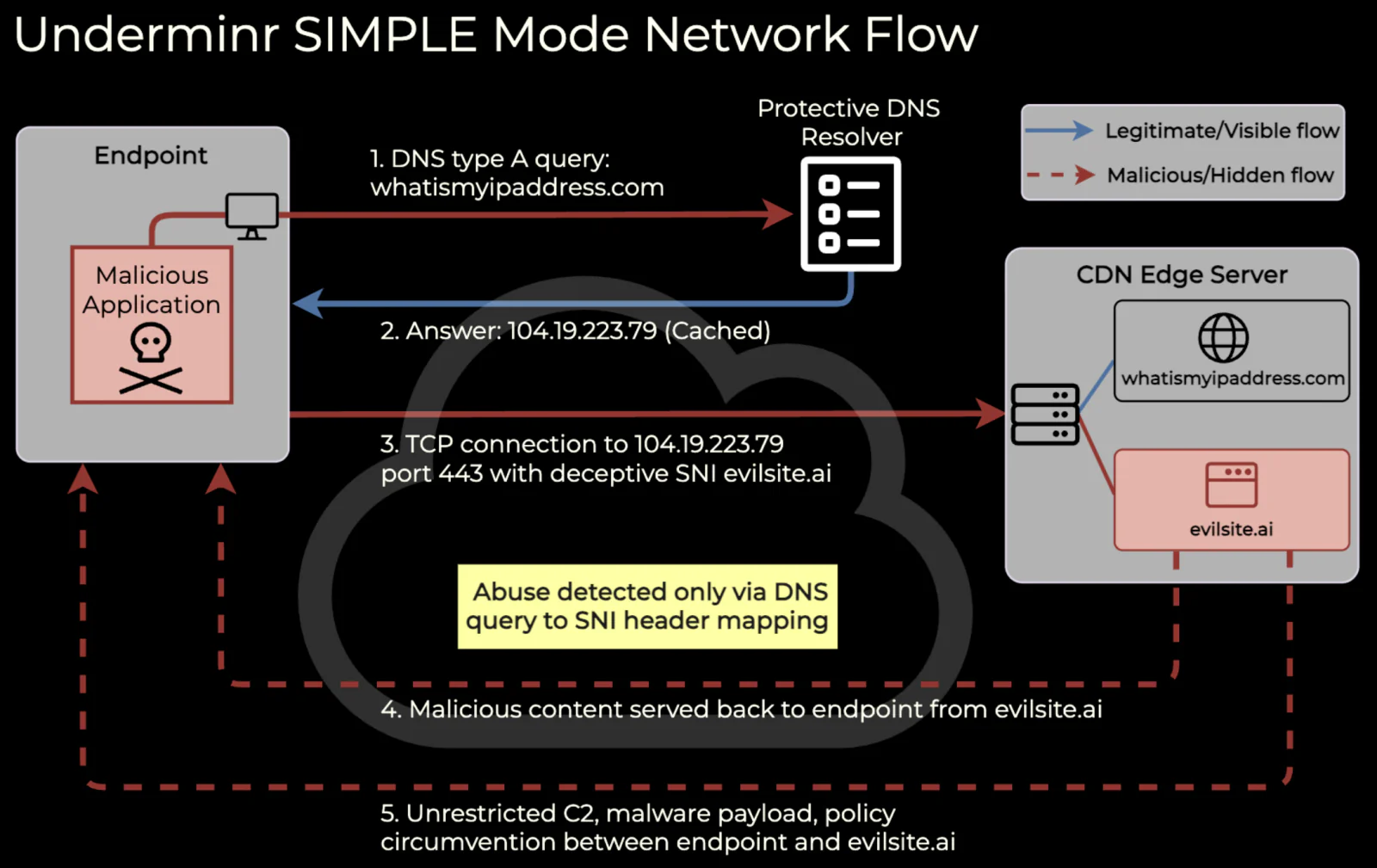
The cybersecurity researchers at ADAMnetworks recently unveiled a novel evasion technique. This method allows malicious data packets to conceal themselves behind trusted domains and Content Delivery Networks (CDNs). Consequently, this development threatens organizations relying heavily on Protective DNS security frameworks. Furthermore, this exploit endangers everyday website administrators. Their benign domains risk blacklisting due to unexpected proximity to illicit threat behavior.
Mechanics of the Intercept
This emerging exploit bears the moniker Underminr. To initiate the attack, an adversary first harvests the authorized IP address of a whitelisted CDN domain. Subsequently, the threat actor establishes a connection to that identical edge infrastructure node. However, the attacker specifies an entirely different domain within the Server Name Indication (SNI) or HTTP Host headers. As a result, the boundary defense mechanism registers a legitimate query. Meanwhile, the actual data transaction routes covertly to an unauthorized destination.
Divergence from Domain Fronting
The research authors emphasize that Underminr diverges significantly from legacy domain fronting methods. Under the ancestral paradigm, the outer domain and SNI typically mirrored a reputable entity. Conversely, the true destination remained obscured inside the encrypted HTTP Host header. In this new architectural variant, the definitive mismatch materializes between the DNS resolution response and the literal hostname served by the CDN on a shared IP resource.
Operational Deployment Risks
ADAMnetworks confirms observing these specific architectural misconfigurations within active exploitation telemetry. According to their assessments, this strategy effectively circumvents Protective DNS filters. Moreover, the technique conceals command-and-control (C2) channels, distributes secondary malware payloads, and facilitates silent data exfiltration. Furthermore, the integration of Encrypted Client Hello (ECH) introduces an acute risk vector. This protocol shields the internal SNI from passive inspection. Thus, defenders cannot easily correlate DNS lookups with the ultimate TLS endpoints.
The intelligence brief outlines multiple attack configurations. In a rudimentary scenario, a malicious application obtains the IP of a trusted domain. Subsequently, it attaches to that target address using a manipulated SNI variable. Conversely, the split scenario initializes a legitimate-looking primary TLS session. After passing the preliminary boundary checks, the client establishes a new connection to the same CDN node with a falsified identity. Alternatively, direct connection to the IP address completely eliminates DNS log footprints for the hidden domain.
Perimeter Hardening and Remediation
For domain administrators, this operational vulnerability introduces considerable frustration. A website remains fundamentally exposed if its DNS records point to a shared CDN framework accepting arbitrary tenant signatures on the same cluster. To mitigate this, ADAMnetworks debuted a specialized Underminr diagnostic utility. This platform categorizes domains under clear green, amber, or crimson risk profiles based on automated test evaluations and known abuse tracking databases.
To fortify perimeters, the firm advises security engineers to audit approved domains independently from hidden endpoints. Furthermore, teams must continuously validate correlations between the local DNS cache, SNI parameters, Host definitions, and CDN IPs. Additionally, administrators should filter ECH telemetry by orchestrating controlled DNS responses. For website proprietors, remediation requires direct coordination with CDN vendors. Alternatively, organizations can migrate web assets to isolated environments where routing mechanisms bind rigidly to individual client accounts.
Support Our Threat Intelligence
If you find our technology report and cybersecurity news helpful, consider supporting our work.
 Buy Me a Coffee
PayPal
Buy Me a Coffee
PayPal


