Monero P2Pool Critical Vulnerability: Urgent V4.16 Update
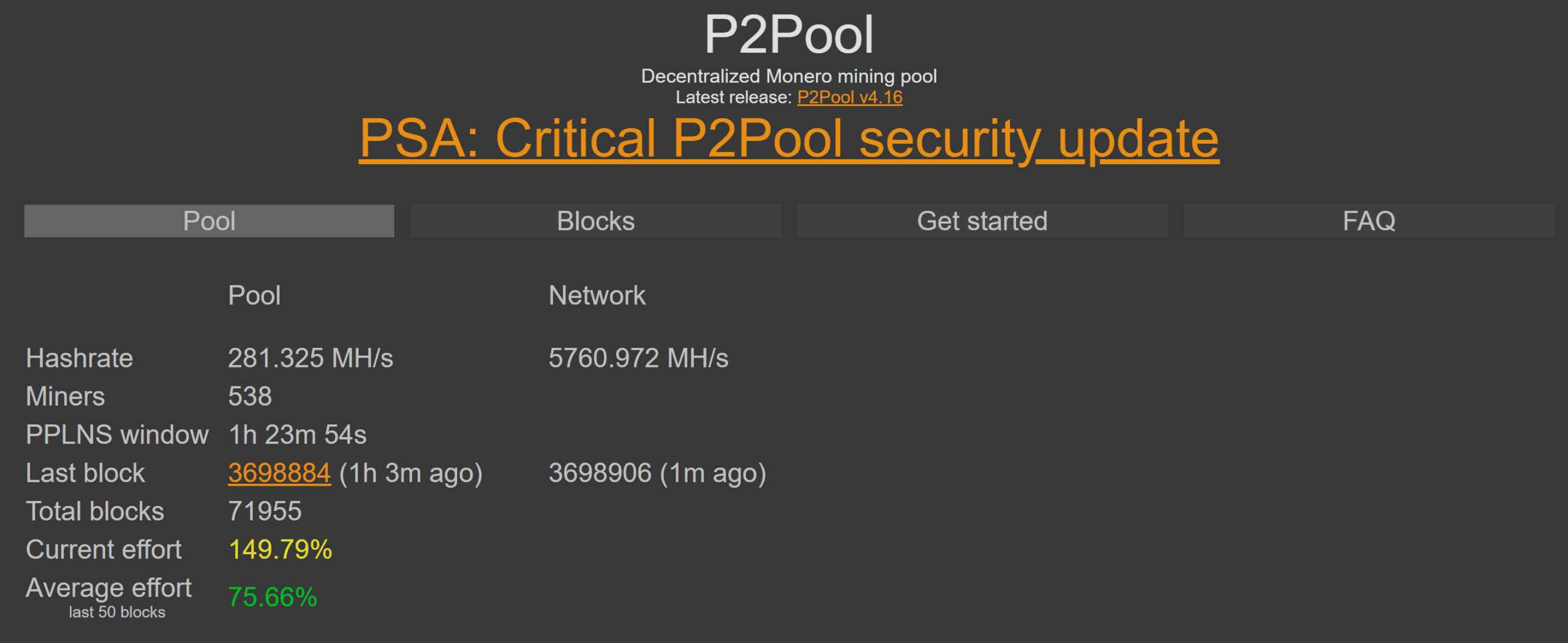
Monero miners have received an urgent warning: a critical vulnerability discovered within P2Pool is currently being exploited in live attacks. Project developer sech1 reported this active exploitation on Reddit. He implored all network participants to immediately upgrade their P2Pool software to version 4.16. Failure to update could result in future mining block rewards being siphoned by malicious actors.
Decentralized Mining Under Threat
P2Pool operates as a fundamentally decentralized mining pool for Monero. Participants deploy independent nodes. This ensures autonomous reward distribution without relying on a centralized server or third-party custodians. This architecture significantly mitigates the risks associated with conventional pools. However, the newly unearthed flaw strikes directly at the core share-accounting mechanism. This crucial system dictates the magnitude of payouts.
Under normal operational parameters, every successful mining result generates a single, unique share. This vulnerability critically subverted that foundational rule. An attacker could mine one legitimate share and subsequently synthesize thousands of fraudulent duplicates. Alarmingly, older P2Pool iterations authenticated these illicit copies as legitimate entries. An official security advisory on GitHub detailed a severe metric. A solitary valid result could spawn over 12,000 counterfeit shares.
Manipulating the Reward Mechanism
The attack directly manipulated the PPLNS payout window. P2Pool utilizes this protocol to apportion block rewards among legitimate miners. These fabricated shares inundated the system window. They effectively displaced the honest computational labor of other participants. Consequently, the assailant could hijack up to 80 percent of the aggregate reward. Upon mining the subsequent share, they could monopolize the entire block payout.
Understanding the True Risks
Fortunately, this defect does not grant access to digital wallets. It does not compromise cryptographic keys or permit the theft of previously secured coins. The peril is strictly confined to future disbursements. Miners utilizing deprecated versions may continue operations normally. However, a substantial fraction of their rightful rewards will inadvertently flow to the attacker. Updated and obsolete nodes run a severe risk during an active attack. They might diverge into distinct, incompatible sidechains. Legacy clients could remain hopelessly stranded on an invalid fork for extended periods.
According to sech1, the initial onslaught targeted the P2Pool Mini and Nano chains. This predominantly affected segments where the mining populace had neglected to transition to version 4.16. Subsequently, the incursion expanded to compromise the P2Pool Main network. The advisory timestamped this breach at 00:02:46 UTC on June 16th. The developer issued a further caution at the time of publication. Over half of the computational hashrate across Mini and Nano was still tethered to the antiquated code. This systematically hemorrhaged future payouts directly to the perpetrator.
Strategic Countermeasures and Remediation
In a decisive countermeasure, sech1 and DataHoarder announced a tactical response. They had commenced mining specifically tailored blocks. This strategic maneuver intercepted the attacker’s illicit payouts. It aims to ultimately orchestrate restitution for the victimized miners. The project architects intend to solicit supplementary hashrate from the community. They will proceed once they meticulously prepare a secure, equitable redistribution framework.
The definitive remediation is already accessible within the official P2Pool v4.16 release. This crucial update comprehensively seals the consensus vulnerability. It introduces substantive enhancements to the overall networking architecture. The code now incorporates TLS support for merged mining via JSON-RPC. It also institutes rigorous node stall detection protocols. The development team emphasizes a straightforward defense strategy. Fortifying your system simply requires upgrading the P2Pool software and reinitiating the application. There is absolutely no necessity to migrate funds. You do not need to alter wallet configurations in response to this anomaly.
Support Our Threat Intelligence
If you find our technology report and cybersecurity news helpful, consider supporting our work.
 Buy Me a Coffee
PayPal
Buy Me a Coffee
PayPal


