Lazarus Memory-Only Malware: Advanced Financial Sabotage
The more stealthy a malicious software remains, the longer its capacity to endure within a compromised system. This guiding philosophy drives the North Korean-linked Lazarus group in its latest offensive against banking institutions and cryptocurrency platforms. As detailed in recent security research, Lazarus targets the financial sector with a memory-only malware toolset to ensure deep network infiltration.
The Volatile Arsenal: DPAPILoader, RemotePELoader, and RemotePE
Researchers at Cognyte have documented sophisticated incursions utilizing a tripartite toolkit consisting of DPAPILoader, RemotePELoader, and RemotePE. The defining attribute of this digital arsenal lies in its volatile execution strategy. Specifically, the malicious payload never touches the physical storage disk, operating exclusively within volatile random-access memory. Consequently, post-compromise detection and traditional forensic investigations are rendered exceptionally arduous for defenders.
Deconstructing the Multi-Stage Attack Architecture
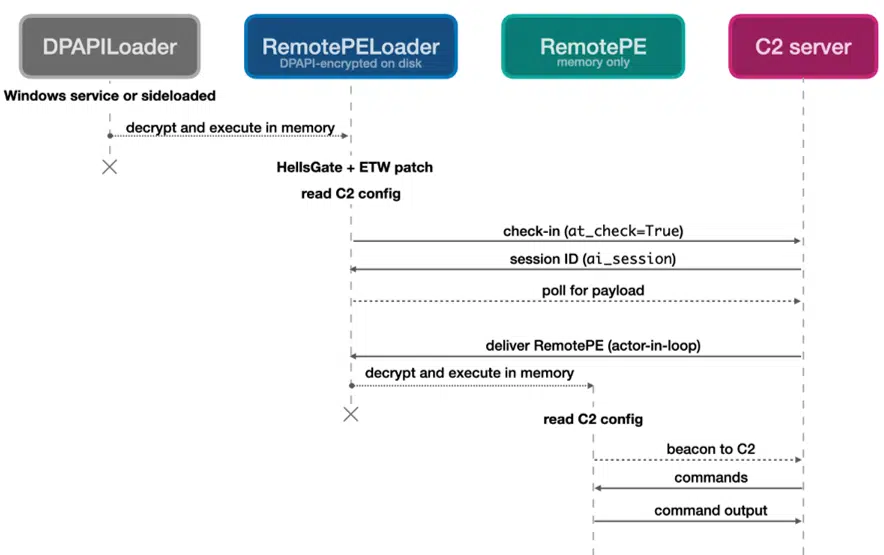
The architecture of the assault is meticulously orchestrated across successive phases to bypass security layers. Leveraging the native Windows Data Protection API (DPAPI), the initial component decrypts and executes its successor safely. This secondary element then fetches the ultimate payload directly from the adversaries’ command-and-control servers. Finally, the tertiary component, a remote access trojan (RAT), deploys entirely within memory. This grants the cybercriminals absolute sovereignty over the infected system, enabling arbitrary command execution, file manipulation, and covert data exfiltration.
The Sophistication of Environmental Binding
A particularly noteworthy technique discovered within this campaign involves strict environmental binding. By utilizing the machine-specific DPAPI mechanism, the malicious code is cryptographically tethered to the victim’s unique hardware signature. Therefore, executing the payload on any alternative device becomes virtually impossible. As a result, each infection manifests as entirely unique, which effectively neutralizes the efficacy of traditional file-signature-based detection mechanisms.
A Shift Toward Strategic Stealth and Espionage
Historically, the Lazarus group has specialized in financially motivated cyber campaigns, including high-profile cryptocurrency heists. However, this latest paradigm underscores a tactical pivot. Beyond mere technical sophistication, the syndicate is increasingly prioritizing stealth and prolonged persistence within victim networks. This methodology was traditionally associated almost exclusively with state-sponsored intelligence organs rather than simple financially motivated groups.
Proactive Remediation and Defensive Countermeasures
To mitigate these profound risks, security analysts recommend enforcing the principle of least privilege by restricting administrative credentials immediately. Furthermore, organizations must deploy behavioral memory-scanning threat detection solutions and augment endpoint telemetry collection. Finally, security operations centers must vigilantly monitor anomalous DPAPI function calls and atypical outbound network traffic patterns.
Support Our Threat Intelligence
If you find our technology report and cybersecurity news helpful, consider supporting our work.
 Buy Me a Coffee
PayPal
Buy Me a Coffee
PayPal


