Tag: USB-C

  • Nintendo Locks Down Switch 2 USB-C Port: Breaking Third-Party Dock Compatibility with Proprietary Encryption

    Nintendo has complicated matters for those hoping to connect the Switch 2 to a television or augmented reality glasses while traveling, using a standard USB-C cable. Though the port itself remains universal in design, the Japanese company has implemented a proprietary encryption and authentication system that effectively blocks third-party accessories.

    According to accessory manufacturers, Nintendo employs a dedicated encryption key and likely a proprietary chip to distinguish its official docks from all others. An analysis of the USB Power Delivery protocol revealed that, instead of initiating a standard handshake, the Switch 2 communicates in a language comprehensible only to Nintendo’s official dock or certified accessories.

    As a result, most generic hubs and docking stations simply do not function. Even Jsaux—a company known for its swift release of a Steam Deck-compatible dock—has paused development of a similar product for the new console, citing authentication hurdles. The issue extends beyond mere power requirements (Switch 2 demands up to 20V); it lies within the encrypted handshake process.

    At present, only one third-party accessory has been confirmed to work with the new console: the Antank S3 Max dock. It contains a chip capable of “speaking” Nintendo’s cryptic dialect, including the transmission of a mysterious sequence: 33 01 07 DA 06 01 6D 68. While this confirms compatibility, it also introduces risk—should Nintendo alter its encryption keys in future updates, these devices could suddenly cease to function.

    Manufacturers admit that firmware updates may offer a lifeline, but only if the accessory model is equipped with the necessary support. Antank has pledged to release such updates should Nintendo modify its authentication algorithms. However, technical details about these solutions remain tightly guarded.

    This move away from compatibility affects not only compact third-party docks, but also high-end video glasses like the Xreal One—whose price may exceed that of the console itself. Now, connectivity requires a new device, the Xreal Neo, which remains in development. What was once a universal port is fast becoming a walled garden.

    Nintendo has declined to comment on the existence of an authentication chip or its role in deliberately blocking unauthorized accessories. However, the trend is clear: even the original Switch exhibited non-standard behavior when connected to unofficial docks—occasionally causing hardware damage.

    The situation is further complicated by the new design: the Switch 2 features bottom-facing ventilation and an active cooling fan built into the official dock. Yet, third-party solutions like Antank have shown no degradation in thermal performance during extended use—on the contrary, in some cases, the console ran cooler.

    Nintendo could have chosen to open the interface, empowering users to select any accessory that suits their needs. Instead, it opted for control. Sadly, the “universality” of USB-C remains, once again, a promise unfulfilled.

  • The European Union has decided to require consumer electronics to use USB-C as a unified charging interface in 2024

    The European Parliament confirmed earlier that it will be mandatory before the end of 2024 that consumer electronics including iPhones and AirPods must use USB-C as a universal charging interface design.

    hijack iPhone Lightning cable

    “Lightning cable”by robpegoraro is licensed under CC BY-NC-SA 2.0

    According to the European Parliament, this adjustment will enable all consumer electronic products such as mobile phones, tablets, and cameras sold in the EU to be charged through the USB-C interface. This adjustment will further extend to larger consumer electronics products such as laptops from the spring of 2026.

    In the view of the European Parliament, this adjustment will help simplify the convenience of consumer electronic products, while reducing the proportion of the electronic waste generated, while increasing the service life of consumer electronic products.

    The European Parliament also requires that all consumer electronic products that operate through wired charging and operate with an electrical power of less than 100W must be equipped with a USB-C charging interface, and support fast charging and the same charging efficiency that allows users to recharge most consumer electronic products with the same charger.

    In addition, the European Parliament has also passed a decree that requires manufacturers of consumer electronics products to clearly label, so that consumers can easily know which charging specifications can be used. Smaller devices such as smart watches, health bracelets, and sports tracking devices are currently exempted, but they are expected to use the same charging interface design as technology advances in the future.

    After this vote, the European Commission will formulate relevant bills before the end of 2024, and will further add the wireless charging design scheme to make it a market standard specification to avoid fragmentation of such charging methods due to differences in specifications.

    The current relevant decree will come into force 20 days after the official EU announcement and will require manufacturers to comply with the specifications for consumer electronics products launched after the next 24 months. The consumer electronics products launched before this do not need to be readjusted and can continue to be sold in the market.

  • The European Union requires all devices to use USB-C as a universal charging port by the fall of 2024

    About two months ago, the European Union passed a proposal to establish USB-C as the standard port for all devices such as smartphones, tablets, cameras, headphones, portable speakers, and handheld game consoles. Charging ports and fast charging technology will be harmonized to create a common charging solution for all related devices.

    Recently, the European Union reached an agreement on legislation for a universal charging solution that will make all mobile phones sold in the EU mandatory to have a USB-C port by the autumn of 2024. Although the bill still needs to be approved by the EU Parliament and the Council, considering that the parties have basically reached an agreement on the details, it is only a matter of process and form in the end. After more than a decade of work, an agreement on a universal charging solution has finally been reached between the different EU agencies.

    iPhone 11 USB-C

    In addition to establishing USB-C as a unified standard port, the EU exempts devices that are too small to have a USB-C port, such as smartwatches, fitness trackers, and some sports wearables. In addition, the EU also recommends that chargers and electronic equipment be sold separately to improve consumer convenience and reduce the production and disposal of chargers to effectively support environmental protection and digital transformation. The EU estimates that the new bill could save consumers 250 million euros a year in buying unnecessary charging heads and reduce e-waste by around 11,000 tonnes a year.

    The EU’s new rules will provide a 24-month grace period for all devices, extending the grace period to 40 months for laptops. The reason is that the EU wants notebooks to use the PD 3.1 standard, which is suitable for 100W to 240W power adapters to meet the charging needs of some high-end models.

    As the only smartphone maker on the market that still uses a proprietary Lightning port instead of a USB-C port, Apple is clearly the one most affected. According to statistics, Apple will sell 241 million iPhones worldwide in 2021, of which about 56 million will be sold in Europe.
  • EU disagrees with Apple and promotes USB-C to be more beneficial to consumers and the environment

    The European Union has been promoting the standardization of electronic product interfaces many years ago. At the same time, some EU member states are also promoting the repairability and repairability of electrical products.

    The essential purpose of these measures is to improve the versatility of electronic products and facilitate maintenance and avoid waste of resources caused by products of different standards and inability to repair.

    In particular, various heavy metals used in electronic products will cause serious environmental pollution, and heavy metals will seriously threaten human life and health through bioconcentration.

    In this context, the European Union promotes the standardization of the USB-C interface. At present, most of the newly launched Android devices have adopted this interface, but Apple still refuses.

    hijack iPhone Lightning cable

    “Lightning cable”by robpegoraro is licensed under CC BY-NC-SA 2.0

    Lightning is an interface widely used by Apple on the iPhone. This interface is proprietary to Apple. Apple believes that there are a lot of devices using this interface. If the interface is replaced, it will cause a large number of existing data lines to be abandoned and cause a waste of resources.

    At the same time, Apple believes that only allowing the use of the USB-C interface in the market will also stifle industry innovation rather than encourage innovation, and this behavior will also harm the interests of consumers.

    Based on this view, Apple has not used the USB-C interface on the iPhone so far, but what is funnier is that Apple uses the USB-C interface on some iPads.

    Earlier, there were rumors that Apple was even developing an iPhone without an interface in order not to use the USB-C interface, that is, it is very likely that the iPhone can only be charged wirelessly.

    The EU antitrust commissioner issued a statement saying that European consumers have long complained about incompatible chargers piled up in drawers.

    The EU has given the industry enough time for manufacturers to propose their own solutions, and now the time is ripe for legislative action for universal chargers.

    This is a very important victory for consumers and environmental protection. At the same time, the adoption of legislation to unify charger standards is also in line with the European Union’s green and digital determination.

    EU also said that the relevant proposal is to end the chaotic era of unnecessary and irreplaceable chargers.

    EU said that European consumers can use a single charger for all their portable electronic devices, which is an important step to improve convenience and reduce waste.

    Via: androidauthority

  • USB-C cable with electronic tag will refuse to power the current version of the Raspberry Pi 4

    Recently, the Raspberry Pi Foundation has confirmed that the USB-C cable with electronic tag will refuse to supply the current version of the Raspberry Pi 4 due to misidentification as an audio adapter accessory.

    Eben Upton, a co-founder of the Raspberry Pi fund, said:
    “A smart charger with an e-marked cable will incorrectly identify the Raspberry Pi 4 as an audio adapter accessory, and refuse to provide power. I expect this will be fixed in a future board revision, but for now users will need to apply one of the suggested workarounds. It’s surprising this didn’t show up in our (quite extensive) field testing program.”

    Upton said that this technical analysis article by Tyler Ward provides a detailed explanation of why electronically tagged cables cannot power the Raspberry Pi 4. The current version of the Raspberry Pi 4 can work by using a Type-C cable without an electronic tag with a 5.1V/3A power supply or with an official Raspberry Pi 4 power supply.

    Via: TechRepublic

  • Microsoft solves a shutdown delay error due to USB-C

    As early as Windows 10 Version 1809, users found that computers using USB-C controllers had significant delays if they were turned off. Later, Microsoft confirmed that the shutdown was extended for 60 minutes due to a connector system software interface error, that is, 60 minutes after the shutdown command was issued. In the end, Microsoft spent half a year fixing the problem but it was still an incomplete fix because the user must upgrade the latest version of Windows 10.

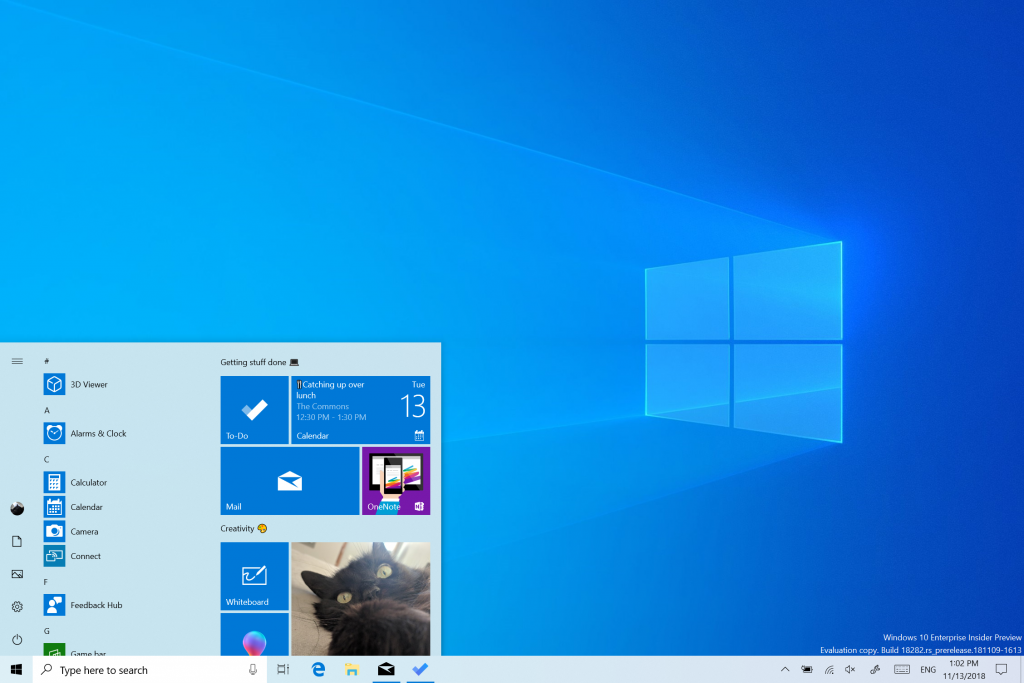
    Windows 10 Insider Preview Build 18282

    Microsoft has announced that it has fixed the shutdown problem based on USB-C controller in Windows 10 Version 1903. The latest solution from Microsoft has been able to solve the shutdown problem, and Microsoft added this fix to the cumulative update launched last month. If users want to resolve this issue, they must upgrade to the latest version of Windows 10 and install at least the routine cumulative update for May 2019.

    And Microsoft has no plans to launch the same program for Windows 10 Version 1809. It is not clear why Microsoft is not willing to fix the old version. Of course, this may also be Microsoft’s practice of urging users to always use the latest version, but this kind of persecution is expected to make corporate users dissatisfied.