OpenAI has unveiled an updated version of its model—GPT-5.1, which the company describes as warmer, more conversational, and more natural in human interaction. According to the announcement, the new iteration demonstrates improved instruction-following and sounds markedly “more human,” even when addressing sensitive topics such as sex, violence, and mental health.
The model is released in two variants: GPT-5.1 Instant, now “warmer, smarter, and better at following instructions,” and GPT-5.1 Thinking, an “enhanced version for complex reasoning—faster on simple tasks and more resilient on challenging ones.” Access is currently limited to paid subscribers, while free-tier users continue to work with GPT-5 (gpt-5-instant-aug15 and the gpt-5-instant-oct3 update).
“We heard clearly from users that great AI should not only be smart, but also enjoyable to talk to. GPT‑5.1 improves meaningfully on both intelligence and communication style,” the company states.
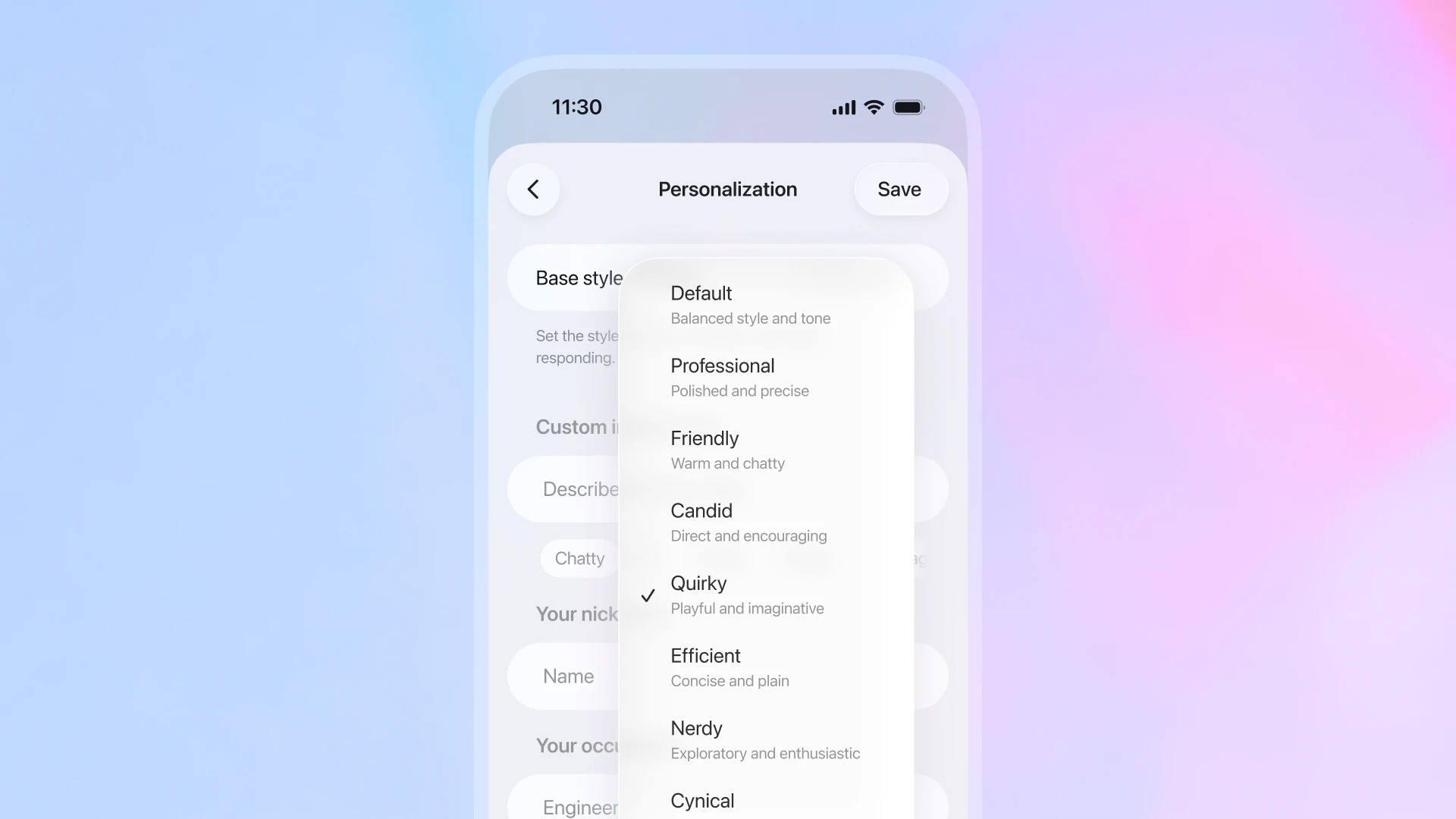
OpenAI has introduced new tools for tone control, allowing ChatGPT to be tailored more personally through flexible sliders. When GPT-5 launched in August, the company introduced four base “personalities”: Cynical, Robot, Listener, and Nerd. In the new version, these have been renamed to Cynic, Efficient, Friendly, and Nerd, with three additional modes added: Professional, Candid, and Quirky.
The company stresses that these stylistic adjustments do not make the AI excessively deferential or sycophantic, problems observed in earlier iterations. OpenAI notes that tuning the tone must not compromise the model’s critical judgment.
The company illustrated the stylistic shift using the same user query. GPT-5 responded in a plain, detached tone:
“Here are a few simple ways to cope with stress…”
GPT-5.1 Instant, by contrast, began its reply in a more empathetic and human voice:
“I’m here with you, Ron — what you’re feeling is completely normal, especially with everything you’re dealing with. Here are a few ways to unwind…”
This emotionally expressive style has already sparked legal disputes. In August, OpenAI became the defendant in a California lawsuit involving a teenager’s suicide; four additional suits followed, alleging that an overly compassionate chatbot contributed to emotional dependency among vulnerable users.
In October, OpenAI reported that approximately 0.07% of active users and 0.01% of weekly messages may indicate mental-health crises such as psychosis or mania. With roughly 800 million active users, this corresponds to about 560,000 individuals each week.
Yet according to GPT-5.1’s internal system map, the new version shows declines in several internal safety metrics—particularly in handling topics involving insults, hate speech, and sexual content. GPT-5.1 Instant also performs worse than the October GPT-5 update on measures related to emotional dependency and violence-related content.
The company acknowledges these regressions but characterizes them as minor and heavily dependent on statistical variance, noting that, as in many AI benchmarks, results may fluctuate depending on methodology.
External evaluations have not yet been published, but OpenAI asserts that GPT-5.1 demonstrates “significant gains” in mathematics and programming tasks—including AIME 2025 and Codeforces—thanks to the introduction of adaptive reasoning, a mechanism that allows the model to adjust its analytical depth based on the complexity of the prompt.
OpenAI further clarifies that GPT-5.1 Thinking “adapts its reasoning to the task,” devoting more time to difficult questions while responding more quickly to straightforward ones. This is intended to reduce the risk of overthinking, a phenomenon in which models begin to err due to unnecessary analytical depth.
Support Our Threat Intelligence
If you find our CVE report and cybersecurity news helpful, consider supporting our work.
 Buy Me a Coffee
PayPal
Buy Me a Coffee
PayPal