Tag: ASRock

  • ASRock AI QuickSet Unleashes Generative AI on Intel Arc GPUs

    At the close of last year, ASRock released the AI QuickSet tool software on Microsoft Windows 10/11 and Canonical Ubuntu Linux platforms, designed to assist users in swiftly downloading, installing, and setting up artificial intelligence (AI) applications. Earlier versions, leveraging AMD’s software and hardware ecosystem, supported a broader range of open-source AI applications and enhanced operational efficiency, garnering considerable appreciation from ASRock’s clientele.

    ASRock has now introduced an Intel Arc GPU version of the AI QuickSet software, supporting Arc A770, A750, A580, A380, and A310 models, thereby broadening its applicability and enabling users of Arc graphics cards to easily engage with generative AI applications.

    The AI QuickSet tool software version 1.0.3i for Windows supports the Microsoft Windows 10/11 64-bit operating system, enabling users to effortlessly install the Stable Diffusion Web UI OpenVINO without delving into complex configuration settings. This AI image generation tool, optimized by the Intel OpenVINO toolkit and used in conjunction with ASRock’s Arc A series graphics cards, delivers exceptional performance due to its powerful computational capabilities.

    ASRock asserts that the Intel Arc GPU version of the AI QuickSet software exemplifies its formidable prowess in software and hardware development and its dedication to user-centric innovation, making the AI QuickSet tool a prime choice for consumers eager to explore generative AI applications.
  • ASRock releases W790 WS R2.0 motherboard

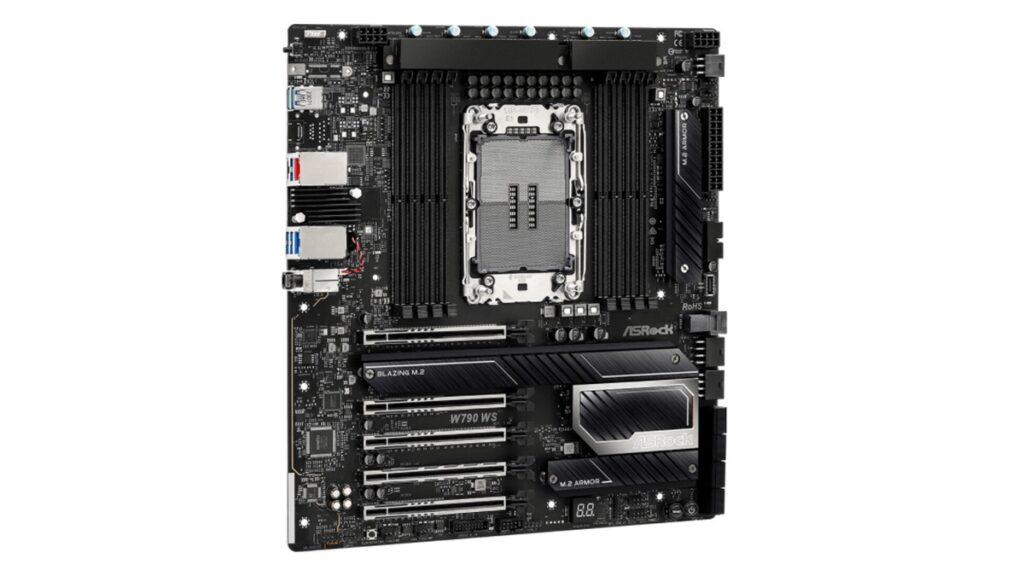
    Last year, Intel unveiled the Sapphire Rapids HEDT/workstation processors, encompassing both the Xeon WX-3400 and WX-2400 series, shortly after which ASRock introduced the W790 WS motherboard. ASRock announced the launch of the W790 WS R2.0 motherboard, a refined iteration of its predecessor, streamlined by reducing some I/O features.

    The W790 WS R2.0 motherboard retains its sleek, black aesthetic with an E-ATX form factor, measuring 30.5 x 27.7 cm. It features a robust 20+2 phase power design on a 14-layer PCB, where the cooling armor in the power region has been notably simplified, omitting heat pipes and cooling fans. It supports quad-channel memory with eight DDR5 memory slots, EEC error correction, and a maximum capacity of up to 2TB; it offers five full-length PCIe slots—two PCIe 5.0 x16, two PCIe 5.0 x8, and one PCIe 4.0 x16, with the PCIe 5.0 slots directly connected to the processor and the PCIe 4.0 slot provided by the PCH. Additionally, there are four PCIe 5.0 x4 M.2 slots, one of which supports M.2 2230/2242/2260/2280 specifications, while the other three accommodate M.2 2260/2280, all equipped with heatsinks; it also provides eight SATA 3.0 interfaces and one PCIe 4.0 x4 U.2 interface.

    ASRock has eliminated the integrated I/O backplate in the new motherboard, also reducing the interface options, no longer supporting Thunderbolt 4 or Wi-Fi 6E. The rear I/O interface includes two USB 3.2 Gen2 Type-A ports, three USB 3.2 Gen1 Type-A ports, a 10G Ethernet port (Marvell AQC113CS), a 2.5G Ethernet port (Intel I226LM), an SPDIF output, and audio ports, with the sound card being a Realtek ALC897. However, it retains the BIOS FlashBack button, simplifying the BIOS updating process. Furthermore, the front I/O still features a USB 3.2 Gen2x2 Type-C socket, along with USB 3.2 Gen1 and USB 2.0 sockets.

  • ASRock launches 4X4 BOX-8040 series mini PC

    ASRock has announced the debut of its 4X4 BOX-8040 series mini PCs, featuring the AMD Ryzen 8040U series APU. The 4X4 BOX-8040 series mini PCs, with dimensions of 110 x 117.5 x 49 mm and weighing 1kg, are powered by the “Hawk Point” processors, offering choices between AMD Ryzen 7 8840U and Ryzen 5 8640U. Both are based on the Zen 4 architecture and manufactured using TSMC’s 4nm process, with a TDP of 28W. The Ryzen 7 8840U has 8 cores and 16 threads, a base frequency of 3.3 GHz, and a maximum boost frequency of 5.1 GHz. Its integrated Radeon 780M GPU boasts 768 stream processors and a frequency of 2700 MHz. The Ryzen 5 8640U, with 6 cores and 12 threads, has a base frequency of 3.5 GHz and a maximum boost frequency of 4.9 GHz. Its Radeon 760M GPU includes 512 stream processors with a frequency of 2600 MHz.

    The 4X4 BOX-7040 series mini PCs are equipped with two DDR5 memory slots (SO-DIMM), supporting up to 96GB of DDR5-5600 memory. They feature two PCIe 4.0 x4 M.2 Key M slots (2242/2280 and 2242 specifications) for storage expansion and offer Wi-Fi 6E and Bluetooth 5.2 connectivity. The units are fitted with two network card interfaces, namely Realtek RTL8111H (1 Gbps) and RTL8125BG (2.5 Gbps), and include two HDMI 1.4b ports, two USB4 ports (supporting DP 1.4 mode video output), and can support up to four display outputs. Additionally, there is one USB 3.2 Gen2 Type-A port, two USB 2.0 ports, and a 3.5mm audio jack.

    Furthermore, the 4X4 BOX-8040 series mini PCs come with an onboard TPM 2.0 module, compatible with Windows 10 and 11, and support VESA mounting, enabling them to be affixed to the back of a monitor to conserve desk space. The specific market release date and pricing details for the 4X4 BOX-8040 series mini PCs remain undisclosed.

  • ASRock launches Challenger series monitors

    ASRock has announced the introduction of its Challenger series of monitors, initially featuring the models CL25FF and CL27FF. Last year, ASRock, with its Phantom Gaming product lineup, officially ventured into the gaming monitor market, offering gamers novel display solutions. The debut of the Challenger series further expands this product range.

    The CL25FF and CL27FF employ 23.8-inch and 27-inch IPS panels, respectively, boasting an expansive 178°/178° viewing angle. With a resolution uniformly set at FHD (1920 x 1080), they ensure visuals that are both crisp and vibrant. These monitors feature a 100Hz refresh rate, a rapid 1ms response time (MPRT), and a luminance of 300 nits. Their contrast ratios stand at 1300:1 for the CL25FF and 1000:1 for the CL27FF, with an impressive sRGB color gamut coverage of 99%. Melding anti-glare and flicker-free technologies, they combat screen flickering, enhancing display fluidity and retaining a richer color palette for a more authentic and lively representation. Furthermore, a low blue light mode ensures users’ eyes are protected during prolonged use. They also incorporate AMD FreeSync technology, effectively eliminating screen tearing.

    These gaming monitors have secured the Energy Star 8.0 certification. They come equipped with an HDMI 1.4 port and a VGA interface. The accompanying stand allows a tilt range from -5° to 15°, and additionally, they support 100 x 100 mm VESA wall mounting, facilitating usage with articulating arms. ASRock has yet to disclose the pricing and specific release date for the Challenger series gaming monitors.

  • ASRock Launches New DeskMini B760 Mini PC

    Over the past few years, ASRock has unveiled a myriad of compact quasi-systems, garnering accolades and commendations from a vast swathe of aficionados, thereby establishing a sterling market reputation. Recently, in an understated manner, ASRock has introduced its avant-garde DeskMini B760 series, anticipated to grace the market posthaste.

    The DeskMini B760 series, with its svelte dimensions of 155 x 155 x 80 mm and a mere volume of 1.92L, seamlessly carries forth the aesthetic blueprint of the DeskMini B660 lineage. It extends compatibility to Intel’s 12th/13th generation Core processors with a maximum TDP of 65W, permitting users to deploy products fitted for the LGA 1700 socket, whilst ensuring cooler mounting heights remain ≤ 47mm. It’s furnished with a pair of DDR4 memory slots (SO-DIMM), endorsing up to a lavish 64GB of DDR4-3200 memory. Furthermore, it boasts a Blazing M.2 slot, tailored for 2280-spec PCIe 5.0 SSDs, alongside another Blazing M.2 slot suited for 2280-spec PCIe 4.0 SSDs. In addition, there are two 2.5-inch drive bays, congenial for hard drives with heights of 7mm/9.5mm, connected via a sprightly 6.0Gb/s SATA 3.0 interface, offering an option for RAID 0/1 configurations. Leveraging an M.2 2230 slot, one can easily incorporate Wi-Fi and Bluetooth modules, adhering to the CNVi standard.

    In terms of its frontal I/O offerings, the device is festooned with a USB 3.2 Gen2x2 Type-C port (20Gb/s), a USB 3.2 Gen2 Type-A port (10Gb/s), a microphone jack, and a headphone jack equipped with microphone compatibility. On the rear I/O, it presents a USB 3.2 Gen2 Type-C port (with Alt DP mode and PD charging capabilities, 10Gb/s), a duo of USB 3.2 Gen1 Type-A ports (5Gb/s), a couple of USB 2.0 ports, a 2.5 Gbps ethernet port (courtesy of the Dragon RTL8125BG), a D-Sub port, an HDMI port (facilitating 4K@60Hz), and a DisplayPort 1.4 terminal. Additionally, the motherboard possesses a USB 2.0 header. Utilizing the multiple display outputs of the DeskMini B760, one can concurrently helm quad-screen output, thereby bolstering multitasking endeavors and amplifying productivity.

  • ASRock announced the launch of the iBOX 1300 mini PC

    ASRock’s iBOX is a fanless, mini-computer series belonging to the company’s industrial computing division. According to Liliputing, ASRock has recently updated the series with Intel’s 13th-generation Core processors.

    The new iBOX 1300 series encompasses six models with three processors, each offered in both DDR5 and DDR4 versions. All three processors possess a 28W TDP and are designated as UE suffix processors, signifying high-efficiency embedded processors. Among the six devices, the top-tier processor is the i7-1365UE, featuring 2 P-Cores and 8 E-Cores, with a maximum turbo frequency reaching 4.90GHz. The i5-1345UE and i3-1315UE processors are also available.

    As industrial computers, the iBOX 1300 series naturally boasts a more extensive array of I/O interfaces than standard mini-PCs. Its front panel includes four USB Type-A ports, one USB4/Thunderbolt 4, and one USB 3.2 Gen 2 Type-C port; the rear features an HDMI 2.0 and a DP 1.4a port, as well as dual 2.5G Ethernet ports and an RS-232 serial port.

    Additionally, internally, the iBOX provides an M.2 2280 slot with PCIe 4 x4 specifications and a SATA 3.0 interface. Power is supplied through a DC barrel connector, with ASRock providing a 90W power adapter.

    Although detailed specifications are listed on the official website, ASRock has yet to announce the release date and specific pricing for these devices. While these uniquely shaped fanless PCs may not be suitable for the average consumer, they could be precisely what a niche group of fanless cooling enthusiasts require in their industrial computers.

  • ASRock has unveiled the DeskMini 4205 series mini desktops

    ASRock offers four series of mini desktops, namely Mars, Jupiter, DeskMini, and DeskMeet. Recently, ASRock has launched the DeskMini 4205 series mini desktops, equipped with Intel Celeron processors, with a key feature being their fanless passive cooling design.

    In terms of appearance, the DeskMini 4205 is almost identical to other DeskMini models, measuring 155x155x80mm with a volume of approximately 1.92L. The mini desktop is equipped with the Celeron 4205U processor, featuring a 14nm manufacturing process, dual-core and dual-threaded, clocking at 1.8GHz, with a 2MB L3 cache and a default TDP of 15W. The integrated graphics is the UHD Graphics 610, with 12 execution units, a base clock of 300MHz, and a boost clock of 900MHz.

    In terms of ports, the DeskMini 4025 features a microphone jack, a headphone jack, a USB 3.2 Gen1 Type-C port, and a USB 3.2 Gen1 Type-A port on the front panel. On the rear, it has a DC power jack, a D-Sub (VGA) port, an HDMI port, a DP 1.2 port, two USB 3.2 Gen1 Type-A ports, two USB 2.0 ports, and two Gigabit Ethernet ports. All the USB ports on the mini desktop feature an anti-static design.

    In terms of expandability, the DeskMini 4025 series features a PCIe 2.0 x4 M.2 slot, a PCIe 2.0 x2 M.2 slot, a wireless network card M.2 slot, two SO-DIMM DDR4 memory slots, and two 2.5-inch hard drive bays.

    The DeskMini 4205 series has three versions: 4205, 4205/2COM, and 4205/W. All three versions have the same appearance and dimensions. The 4205/2COM version has an additional two COM ports compared to the other two versions, while the 4205/W version comes with an Intel AC-3168 wireless network card. The DeskMini 4205 series can also be fitted with ASRock’s designed RGB light strips, USB HUBs, and rear audio cables for cool lighting effects or to improve its expandability.

    ASRock has not yet disclosed the pricing or specific release date of the DeskMini 4205 series mini desktops.

  • ASRock Launches Jupiter 600 Series Mini PCs

    Asrock has announced the launch of its Jupiter 600 series mini PC, which includes two products, the Jupiter H610, and the Jupiter B660. These products are highly flexible and scalable, with a small footprint, making them suitable for a wide range of industries, such as offices, retail, healthcare, transportation, and industrial applications. They are compact but powerful.

    The Jupiter 600 series mini PC has an overall size of 179 x 178 x 34mm, with a volume of only about 1.1 liters. It supports Intel 12th and 13th generation Core processors with a TDP of 65W or less. It has two DDR4 SO-DIMM memory slots, supporting up to 64GB of DDR4-3200 memory, and has three storage options, including one M.2 PCIe Gen4x4 SSD, one M.2 PCIe Gen3x4 SSD, and one 2.5-inch HDD, meeting the demand for fast data transfer and large-capacity storage.

    In terms of interfaces, the Jupiter 600 series mini PC offers nine USB interfaces (the H610 and B660 have different interface configurations), including one USB 3.2 Gen1 Type-C interface on the front and rear panels, and is equipped with a DisplayPort 1.4 interface, a DisplayPort 1.2 interface, and an HDMI interface. In addition, it has audio interfaces, Gigabit Ethernet interfaces, and COM interfaces, and is equipped with an Intel AC3168/AX210 Wi-Fi module, making it an ideal choice for commercial, digital signage, and POS systems. Furthermore, the Jupiter 600 series mini PC is equipped with DASH LAN and TPM functions, providing commercial information protection for enterprises.

    Asrock has not yet provided the price or specific launch date of the Jupiter 600 series mini PC.

  • ASRock Releases New Version of BIOS for X670/B650 Series Motherboards

    With the arrival of the AMD Ryzen 7000X3D series processors, motherboard manufacturers are preparing new BIOS versions for their B650 and X670 series motherboards. These firmware updates will be based on the new AGESA 1.0.0.5 microcode to support the new processors with 3D V-Cache technology.

    ASRock has announced the official release of new BIOS versions for its X670/B650 series motherboards to support the Ryzen 7000X3D series processors with optimizations and has provided a list of specific motherboard models. ASRock is actually the first motherboard manufacturer to offer the new BIOS and has gradually uploaded the new BIOS versions to its official website.

    BIOS Version 1.18 AS03 1.18 AS04
    X670E X670E Taichi X670E Pro RS
    X670E Taichi Carrara X670E Steel Legend
    X670E PG Lightning
    B650E / B650 B650E Taichi B650E Steel Legend WiFi
    B650E PG Riptide WiFi B650E PG-ITX WiFi
    B650 Pro RS B650 LiveMixer
    B650 PG Lightning
    B650M PG Riptide WiFi
    B650M PG Riptide
    B650M-HDV/M.2

    The latest BIOS updates for the aforementioned motherboards can now be downloaded from the ASRock website, and users are advised to update to the latest BIOS version. Currently, the Ryzen 9 7950X3D and Ryzen 9 7900X3D are already on the market with prices of $699 and $599 respectively.

  • Shipments of Taiwan’s four major motherboard manufacturers declined in 2022

    Thanks to the COVID-19 epidemic and the cryptocurrency market, PC components such as graphics cards were hot for a long time from 2020 to 2022, allowing manufacturers to reap huge profits. As one of the important components of PCs, the motherboard did not get many extra dividends during the same period, and the market has turned weak since the beginning of 2022.

    According to DigiTimes, some board practitioners said that the shipments of the four major Taiwanese motherboard manufacturers collapsed in 2022, a decrease of more than 10 million units compared to 2021. Due to the fierce decline, some manufacturers expect that there is not much room for the rise, and the market should reach the bottom. The main goal of ASUS, Gigabyte, and ASRock in 2023 is to stop the decline, while MSI is relatively optimistic and expects to ship volume will increase.

    MSI B760 Tomahawk Wi-Fi DDR4, Source: VideoCardz
    As the number one brand in the motherboard market, ASUS shipped about 15.5 million and 16.4 million motherboards in 2018 and 2019, respectively. At the beginning of 2020, due to the outbreak of the COVID-19 epidemic, shipments decreased significantly, but in the second quarter, there was a contrarian growth. The annual shipments rushed to 17 million units and even exceeded 18 million units in 2021. After entering 2022, the market situation has reversed, causing annual shipments to drop to 13.6 million units, a drop of about 25%, exceeding expectations by nearly 10%, and the results are even worse than before the epidemic.

    Due to the strong shipments of server motherboards, Gigabyte’s shipments have experienced a relatively small decline. In the four years from 2018 to 2021, the shipments were 11 million, 10.5 million, 13 million, and 11 million respectively. By 2022, Gigabytes fell below the 10 million mark, and the annual motherboard shipments will be between 9.4 million and 9.6 million.Due to the support of gaming notebooks and graphics cards, MSI’s performance has been steadily increasing in recent years, but the shipments of motherboards are relatively average. If the OEM part is not included, the shipment volume in 2020 was about 6.7 million units, which increased to 9.5 million units in 2021 and dropped to 5.5 million units in 2022.

    ASRock, which has performed well in the server market in recent years, has shipped 4 million and 4.3 million units in 2018 and 2019 respectively and maintained a level of about 6 million units in 2020 and 2021. However, in 2022, it was directly cut in half, falling to 2.7 million units.

    Looking forward to 2023, Asus’s forecast is quite conservative, and it is believed that there will be a slight downward adjustment, and Gigabyte is expected to be flat. ASRock expects a slight increase. In contrast, MSI’s target is more positive and optimistic, and it is expected that there will be a 15% rebound.